
Solar Panel Installation: The Complete 2025–2026 Practical Guide
Solar Panel Installation
Solar panel installation is one of the most effective ways for homes, businesses, and institutions to reduce electricity costs, increase energy resilience, and lower carbon footprint. With improvements in technology and more accessible financing options, 2025 and 2026 are shaping up to be pivotal years for solar adoption. This guide is written for decision makers — homeowners, facility managers, business owners, and engineers — who need clear, practical advice to plan solar panel installation , procure, and operate high-performing photovoltaic systems that deliver predictable returns.
Why solar panel installation matters now
Electricity tariffs and supply volatility are top drivers for solar uptake. Many customers find a solar panel installation pays back in a few years while continuing to produce low-cost power for decades. Beyond cost savings, solar adds operational resilience — critical for businesses that cannot tolerate downtime — and environmental benefits that are increasingly valued by stakeholders and regulators. Governments and utilities in many regions now offer net-metering and incentives, making the economics more compelling. For organizations seeking lower operational risk, solar is a strategic infrastructure investment as much as it is an energy solution. For detailed technical references and modeling tools, consult resources such as NREL, IRENA, and PVsyst.
Key benefits of solar panel installation
- Reduced operating costs: Properly sized systems cut grid consumption significantly, leading to lower monthly bills and protection against tariff hikes.
- Energy resilience: Hybrid and off-grid installations provide reliable power during outages, reducing downtime for critical operations.
- Predictable expenses: Solar converts variable energy spending into a capital investment with predictable long-term costs.
- Environmental impact: Solar reduces greenhouse gas emissions and supports corporate sustainability goals.
- Increased asset value: Properties with professionally installed solar often command higher resale and rental value.
Types of solar systems and when to choose solar panel installation
- On-grid (grid-tied) systems are the most common for urban customers with stable grid access. They are lower cost, easier to install, and work well with net-metering policies.
- Off-grid systems include batteries and are necessary where grid connection is absent or unreliable. They carry higher upfront costs but offer complete independence.
- Hybrid systems combine grid connection with battery backup. They provide resilience and the ability to shift or store energy to avoid peak tariffs.
Choosing the right architecture depends on the customer’s energy profile, budget, and resilience requirements.
The solar panel installation process: end-to-end
- Initial consultation: Define goals — bill savings, resilience, or both — and collect past energy bills or meter data.
- Site survey: Inspect orientation, roof condition, shading, structural capacity, and access for installation and maintenance.
- Load analysis & system sizing: Use interval data to size the PV array and, if needed, battery capacity in kWh.
- Detailed design: Produce a PV layout, stringing diagram, inverter selection, earthing plan, and protection schematic.
- Permitting & approvals: Apply for net-metering, electrical permits, and any local clearances; this can vary by utility.
- Procurement: Source panels, inverters, mounting, cables, and protective devices — prioritize bankable brands with local support.
- Installation: Mechanical fixing, electrical interconnections, inverter installation, commissioning tests, and O&M handover.
- Commissioning & monitoring: Verify performance through tests; set up remote monitoring for alerts and performance tracking.
- After-sales support: Warranty management, periodic maintenance, and performance optimization.
Key components and selection criteria of Solar Panel installation
Solar Panel Selection
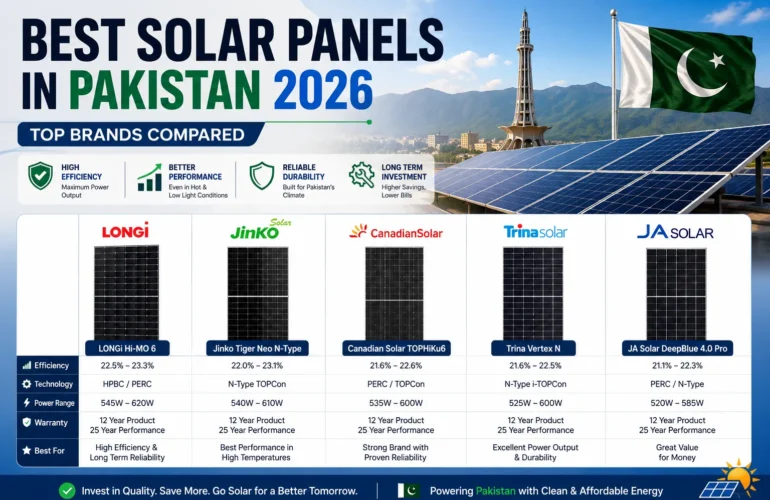
- Efficiency and power density: Higher-watt panels reduce balance-of-system costs on constrained roofs.
- Reliability & warranty: Choose manufacturers with product and performance warranties and a strong track record.
- Temperature coefficients: Panels with lower negative coefficients maintain higher output in hot climates.
Inverter / Power Conversion
- Choose inverters with suitable MPPT count for your array layout and with proven reliability.
- Hybrid inverters for systems that combine storage and grid interaction simplify integration and controls.
Mounting & Structure
- Materials and galvanization standards matter in corrosive environments. Wind-rated racking reduces the risk of failure.
- Roof penetrations must be waterproofed and documented.
Battery Storage (if applicable)
- Chemistry choice affects cost and lifetime (LFP is favored for long-life stationary storage).
- Consider cycle life, depth of discharge limits, and warranty coverage.
Balance of System
- Use appropriately sized, flame-retardant cables, DC isolators, surge protection devices, and quality AC protection.
- Proper earthing and lightning protection reduce damage risk.
Sizing methodology and performance expectations
Accurate sizing starts with real consumption data. Request 12–24 months of bills or interval data if available. For typical locations, estimate annual yield using local solar irradiance values and apply realistic loss factors (soiling, temperature, inverter losses, shading). Example ballpark yields:
- 5 kW rooftop system: typical annual yield 6,000–8,000 kWh depending on location and orientation.
- 10 kW: 12,000–16,000 kWh per year.
- 50 kW commercial rooftop: 60,000–80,000 kWh per year.
Model using PVsyst or similar tools when accuracy matters for financial modeling and to produce month-by-month forecasts that feed your cashflow model. Learn more about modeling tools at PVsyst and best-practice resources from NREL.
Cost drivers and financing
Costs vary by component quality, labor, permit fees, and site complexity. Common cost drivers:
- Component tier (Tier 1 vs budget modules).
- Inverter type (string vs. central vs. hybrid).
- Mounting complexity and roof repairs required.
- Battery inclusion and sizing.
- Cable runs and electrical upgrades (transformer or service size).
Financing options include cash purchase, bank loans with green financing, lease-to-own, or PPAs where applicable. Ask for a detailed cashflow model with sensitivity analysis for tariff escalators and degradation to make an informed decision. For international financing guidance and case studies, see IRENA.
Realistic payback expectations
Payback is site-specific. On-grid residential systems often see paybacks in 3–6 years; commercial projects that offset peak-demand charges may see faster returns. Include avoided generator fuel and maintenance costs for off-grid or hybrid comparisons. Sensitivity to tariff increases, panel degradation, and changes in net-metering policy should be included in your scenario planning.
Site and structural considerations
- Structural engineer validation for rooftop load capacity is necessary for older buildings or when panels plus racking add significant weight.
- Fire safety clearances, aisle width for maintenance, and safe access must be planned.
- Avoid shading from nearby obstructions; when unavoidable, plan string layouts, or use microinverters/optimizers.
- Plan cable routing to minimize voltage drop and maintain clear separation between DC and AC wiring for safety.
Permitting and net-metering
Net-metering procedures differ by utility and region. Expect paperwork, inspections, and interconnection agreements. A good installer will manage this process and liaise with the utility to speed approvals. Time allowances for net-metering can materially affect project schedules, so account for utility timelines in your project plan. Check your local utility or energy regulator website for exact procedures and forms.
Operations, monitoring, and maintenance
Remote monitoring with performance dashboards is standard; set up alerts for string mismatch, inverter faults, and underperformance. Annual preventative maintenance should include panel cleaning in dusty regions, torque checks on fasteners, and inspection of earthing and protection devices. Keep a spare parts kit for critical inverter components and maintain a clear RMA process for panel or inverter warranty claims.
Risk mitigation & quality control
- Procure bankable components and require factory test certificates and batch traceability where possible.
- Conduct peak power tests and IV curve measurements post-installation on select strings to verify performance.
- Include performance guarantees relative to modeled yield, and ensure contractual remedies for persistent underperformance.
Choosing the right Solar Panel Installation
Key evaluation criteria:
- Engineering capability and documented references.
- Local presence and service network.
- Clear contract with milestones, penalties, and warranty responsibilities.
- Transparent pricing with line items and assumed values (irradiance, degradation).
Gravity Engineering Solutions positions itself as an engineering-first installer with strong local service and end-to-end project delivery. Ask for references and visit operational sites they have commissioned to verify workmanship. For contact and free site survey, visit Gravity Engineering Solutions – Contact / Survey. For general information, visit Gravity Engineering Solutions Website.
Sector-specific considerations of Solar Panel Installation
Residential
Focus on aesthetics, roof penetrations, and hybrid options for critical circuits. Integrate inverters and battery enclosures in accessible but sheltered locations.
Commercial
Prioritize demand management, rooftop layout optimization, and minimal downtime during installation. Consider net-metering or self-consumption strategies depending on tariff rules.
Industrial
Conduct structural assessments, plan safety protocols for installations near heavy equipment, and use central inverters or multiple string inverters as required by scale.
Agricultural
Use solar for pumps and irrigation with tailored off-grid or hybrid solutions to reduce diesel use and operational cost; design systems to meet seasonal irrigation cycles.
Case studies and outcomes of Solar Panel Installation
Short example: A 50 kW rooftop installation for a manufacturing unit reduced daytime grid draw by 85% and cut peak demand penalties by 40%, producing a 2.8-year simple payback when fuel, maintenance, and downtime savings are included. Residential example: A 5 kW home system offset 70% of monthly bills and reached payback in 4.5 years due to higher daytime tariffs and favorable net-metering credits. These examples underscore the importance of matching design to site-specific loads and tariff structures.
Common mistakes to avoid
- Accepting vague equipment descriptions. Ask for exact model numbers and datasheets.
- Focusing solely on panel price rather than system LCOE.
- Skipping structural verification.
- Not clarifying who will handle net-metering paperwork and timeline.
- Forgoing a clear performance warranty or monitoring setup that would alert you to underperformance.
Detailed ROI example (numeric)
To make decisions confidently, run a simple numeric example. Assume a 5 kW on-grid system with expected annual energy production of 7,000 kWh. If your retail electricity tariff is PKR 30 per kWh and the system cost is PKR 170,000 (turnkey), the first-year energy value is approximately 7,000 kWh × PKR 30 = PKR 210,000. Simple payback = system cost / annual savings = 170,000 / 210,000 = 0.81 years. This simplified example is intentionally aggressive — in practice include conservative yield assumptions, degradation, and any financing costs. If you assume only 5,000 kWh/year at the same tariff, annual value is PKR 150,000 and payback becomes 1.13 years, still attractive in high-tariff environments. For accurate planning, request month-by-month modeled yields and create best/worst/base case financial scenarios.
Procurement & contracting tips
- Insist on full datasheets for panels and inverters, including temperature coefficients, NOCT, and certified test reports.
- Request FAT (Factory Acceptance Test) or at least batch certificates and serial-number traceability for high-value projects.
- Require an itemized contract with milestone payments linked to delivery and commissioning, and define penalties for delays.
- Confirm local support for warranty service: who pays logistics for failed panels or inverters during warranty periods?
Solar Panel Installation timeline & project management
A typical residential project timeline:
- Day 0–7: Site survey and design.
- Day 8–21: Permitting, approvals, and procurement lead time (may vary).
- Day 22–28: Installation and on-site testing.
- Day 29–35: Final commissioning, net-metering inspections, and handover.
Larger commercial projects require a Gantt-style schedule with procurement windows, scaffold erection, civil works, testing, and staged commissioning.
Safety, codes & compliance
Ensure all electrical work follows local electrical codes and that inverters meet grid interconnection requirements. For battery systems, implement fire detection, early suppression (where applicable), and safe access routes. Earthing design should be validated by a qualified electrical engineer, and lightning protection considered for high-risk areas.
Degradation, performance guarantees & long-term planning for solar panel installation
Panels degrade slowly; typical warranties promise 80–85% of nameplate after 25 years. Ask suppliers for degradation rates and request performance guarantees tied to modeled yield. Plan for inverter replacement around year 10–15 and include replacement cost estimates in lifetime budgeting.
Cost-reduction strategies without compromising quality
- Opt for slightly higher-efficiency panels to reduce mounting and labor costs for constrained rooftops.
- Use local installers with strong vendor relationships to reduce logistics costs.
- Stage storage addition: install PV first and add batteries when prices fall or financing is available.
- Consider community or shared solar models for apartment blocks to split costs and maximize panel area.
Integrating solar with EV charging and smart loads
Pairing solar panel installation with smart EV charging gives a higher utilization of daytime generation and can accelerate payback for households with electric vehicles. Smart chargers can follow solar generation, charging vehicles during peak generation windows and using stored energy at night if batteries are present. For commercial fleets, daytime charging matched to solar output reduces fuel and energy bills significantly.
Maintenance schedule and sample checklist of Solar Panel Installation
Monthly:
- Visual inspection of modules and mountings.
- Clear heavy debris if present.
Quarterly:
- Inverter status check and log review.
- Clean modules where soiling reduces yield more than 2–3%.
Annually:
- Electrical torque checks and earthing resistance measurement.
- Performance review vs. modeled output and corrective maintenance where needed.
Expanded FAQs on Solar Panel Installation
Q: Can I finance my solar panel installation?
A: Yes. Many banks and financing partners offer green loans. Gravity Engineering Solutions can support loan documentation and provide cashflow models required by lenders.
Q: Are there incentives or tax breaks?
A: Incentives depend on local policies; consult with your installer and tax advisor. Net-metering remains a primary financial incentive in many areas.
Q: How do panels perform in extreme heat?
A: Panels produce slightly less power per unit when very hot, but modern panels have improved temperature coefficients to reduce losses. Proper ventilation, tilt, and spacing help mitigate heat effects.
Q: How is performance monitored?
A: Remote monitoring platforms track real-time production, historical yields, and alert owners and service teams to issues requiring action.
Q: How long do solar installations last?
A: High-quality systems often produce reliable power for 25–30 years. Inverter replacement and potential battery replacements are expected lifecycle events.
Company contact for Solar Panel Installation
Gravity Engineering Solutions provides full lifecycle solar services: feasibility studies, detailed engineering, procurement support, installation, commissioning, monitoring, and O&M. To move forward:
- Request a free site survey via the Gravity Engineering Solutions website: https://gravitypk.com/.
- Share 12 months of electricity bills (or interval data) for an accurate sizing and financial model. If you are a client, upload bills via their contact page: https://gravitypk.com/expert-solar-installation-pakistan/.
- Review the proposal with emphasis on modeled yields, warranty conditions, and payment milestones. For pricing reference in Pakistan, check Solar System Price in Pakistan. Also use modeling tools like PVsyst or reference libraries from NREL.
Final words on Solar Panel Installation
Solar panel installation is a proven, scalable solution to reduce energy costs and build resilient operations. With disciplined procurement, engineering-led design, and a clear maintenance plan, you can ensure predictable production and a quantifiable return on investment. For site-specific help and a transparent, engineering-driven proposal, contact Gravity Engineering Solutions for solar panel installation via their website and schedule your free assessment today.
Related internal resources: Solar Services • Case Studies • Contact Us. External references: NREL, IRENA, PVsyst, IEA.