
Best Solar Panels in Pakistan 2026 - Gravity Engineering Solutions


Best Solar Panels in Pakistan 2026 – Top Brands Compared (Longi, Jinko, Canadian Solar, Trina, JA Solar)

Confused about which solar panel brand to choose in Pakistan in 2026? Our expert guide to the best solar panels in Pakistan 2026 compares Longi, Jinko, Canadian Solar, Trina, and JA Solar – efficiency, durability, pricing, warranty, and which one suits your home or business best.

Gravity Engineering Solutions – your trusted partner for the best solar panels in Pakistan 2026 and premium installations.

Table of Contents

1. Why Solar Energy is Booming in Pakistan in 2026

Pakistan’s solar market has witnessed explosive growth. Solar imports collectively produced below 1GW in 2018. In early 2026, this grew to a staggering 51GW, making Pakistan one of the fastest-growing solar markets globally. Rising electricity tariffs, persistent load shedding, and falling solar panel prices have pushed millions toward renewable energy. For the latest regulatory updates, visit NEPRA’s official website.

However, with so many brands flooding the market, choosing the best solar panels in Pakistan 2026 can feel overwhelming. This guide compares the top brands that consistently deliver quality: Longi, Jinko, Canadian Solar, Trina, and JA Solar. We analyze efficiency, durability, pricing, warranty, and real-world performance in Pakistan’s hot and dusty climate to help you find the best solar panels in Pakistan 2026 for your home or business.

2. Why Choosing the Matters for Your Savings

The success of any solar system largely depends on selecting high-quality panels. A Tier‑1 manufacturer ensures better performance, longer life, and higher savings. When evaluating the best solar panels in Pakistan 2026, look for:

  • High efficiency – a hallmark of the best solar panels in Pakistan 2026
  • Tier-1 manufacturer status – global recognition for financial stability
  • Strong hot‑climate performance – crucial for Pakistan
  • Low degradation rate – panels that lose less efficiency annually
  • Long warranties – product (12‑15 years) and performance (25‑30 years)
  • Local after‑sales support

The right brand also affects your hybrid solar system price in Pakistan. Premium panels cost more upfront but deliver better long‑term savings. Below, we review the top contenders for best solar panels in Pakistan 2026.

3. LONGi Solar – A Top Contender

LONGi Solar is widely regarded as one of the best solar panels in Pakistan 2026 and globally. Known for its advanced monocrystalline technology, LONGi panels deliver excellent output even in extreme heat. Many experts rate LONGi as the best solar panels in Pakistan 2026 for residential rooftops due to high efficiency and low degradation.

  • Efficiency: Up to 23%+ – among the highest for best solar panels in Pakistan 2026
  • Warranty: 25‑30 years performance warranty
  • Best for: Homes, commercial buildings, net metering
  • Key models: Hi-MO 7 N-Type Bifacial, Hi-MO 6, Hi-MO 10X HPBC 2.0
  • Price: PKR 31 – 33 per watt (N-Type)

LONGi’s panels are efficient and perform well in dusty conditions. They are an excellent choice for domestic solar solutions in Pakistan. Gravity Engineering Solutions frequently recommends LONGi as the best solar panels in Pakistan 2026 for residential installations.

4. Jinko Solar – Reliable Performer Among 

Jinko Solar panels are extremely popular in Pakistan due to consistent performance and strong global reputation. Many homeowners consider Jinko among the best solar panels in Pakistan 2026 because of excellent value for money.

  • Efficiency: High, with low degradation
  • Technology: N-Type Tiger Neo series, monofacial/bifacial
  • Climate performance: Good in dust and heat
  • Best for: Homes, offices, commercial
  • Price: PKR 29.50 – 31.75 per watt

Jinko offers excellent value and is widely available. For those comparing hybrid solar system price in Pakistan, Jinko panels paired with a quality hybrid inverter give a great balance, making them strong candidates for best solar panels in Pakistan 2026 in the mid‑segment.

5. Canadian Solar – Built to Last, Among 

Canadian Solar produces durable and stable panels with reliable output over time. For industrial users, Canadian Solar is often chosen as the best solar panels in Pakistan 2026 due to robust build.

  • Efficiency: Consistent output over decades
  • Build quality: Ideal for Pakistan’s weather extremes
  • Warranty: Excellent support
  • Best for: Industrial units, factories, large homes
  • Popular model: Canadian Topcon (585W) – PKR 31.80 per watt

Canadian Solar is a top contender for best solar panels in Pakistan 2026 when durability is the priority. They are often chosen for large commercial installations and agricultural tube wells.

6. Trina Solar – High Power Density, Cost‑Effective 

Trina Solar is well known for high‑wattage panels, ideal where space is limited. Trina is often recommended as the best solar panels in Pakistan 2026 for budget‑conscious commercial projects.

  • Efficiency: High power density with N-Type technology
  • Heat resistance: Excellent
  • Best for: Commercial rooftops, warehouses, industrial
  • Price: PKR 28.65 per watt – very competitive

Trina offers one of the most cost‑effective options among Tier‑1 brands for best solar panels in Pakistan 2026. Their panels are popular for large‑scale installations where budget matters but quality cannot be compromised.

7. JA Solar – Affordable Entry 

JA Solar offers a solid balance between price and performance. For many Pakistani families, JA Solar represents the best solar panels in Pakistan 2026 when budget is the primary constraint.

  • Efficiency: Good levels with competitive pricing
  • Global reputation: Trusted Tier‑1
  • Availability: Widely available in Pakistan
  • Best for: Budget‑friendly residential systems

JA Solar rounds out the list of best solar panels in Pakistan 2026 as an excellent entry‑level Tier‑1 option. For homeowners who want a reliable brand without paying a premium, JA Solar is a smart choice and still qualifies as best solar panels in Pakistan 2026 for value seekers.

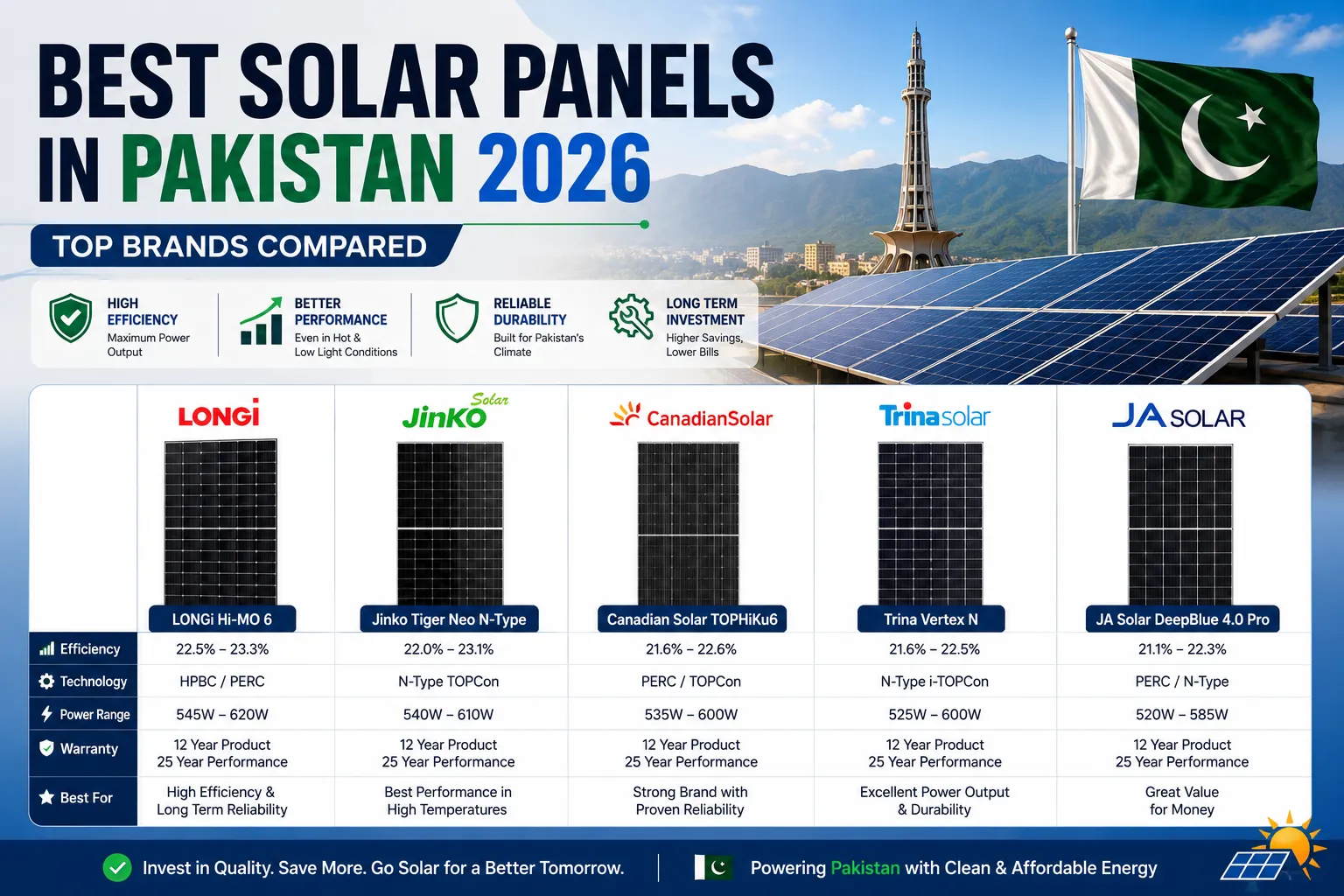
8. Quick Comparison – Which Are the Best Solar Panels in Pakistan 2026 for You?

BrandEfficiencyPrice per Watt (PKR)WarrantyBest For
LONGi (Official) Up to 23%+31 – 3325‑30 yrsHomes, commercial
Jinko (Official) High29.50 – 31.7525 yrsResidential, offices
Canadian Solar (Official) High31.8025 yrsIndustries, large homes
Trina (Official) High28.6525 yrsCommercial rooftops
JA Solar (Official) Good~27 – 3025 yrsBudget homes

All above brands are Tier‑1, suitable for domestic solar solutions in Pakistan. Prices are indicative. For a list of other Tier‑1 brands, refer to Bloomberg New Energy Finance (BNEF). No matter which you choose, you are getting some of the best solar panels in Pakistan 2026.

9. How to Choose the Best Solar Panels in Pakistan 2026 – Step by Step

9.1 Assess Your Roof Space and Budget

Limited space? Choose high‑efficiency panels like LONGi or Trina – these are often the best solar panels in Pakistan 2026 for compact roofs. Tight budget? JA Solar offers the most competitive pricing among Tier‑1 brands.

9.2 Consider Climate and Warranty

LONGi and Jinko perform exceptionally well in high heat and dust. All Tier‑1 brands offer 25‑year performance warranties – ensure local support.

9.3 Pair with a Quality Inverter and Certified Installer

The best solar panels in Pakistan 2026 need a good inverter. Pair with Huawei, GoodWe, Sungrow, or Inverex. Read more about top inverter brands. Work with a certified EPC like Gravity Engineering Solutions for correct installation.

10. Frequently Asked Questions 

Q1: Which is the #1 best solar panel brand in Pakistan in 2026?

A: For overall performance, efficiency, and reliability, LONGi Solar is widely considered the best. However, Jinko, Canadian Solar, Trina, and JA Solar are also excellent choices depending on your budget and needs. All are among the best solar panels in Pakistan 2026.

Q2: Which solar panel lasts longest in Pakistan’s hot climate?

A: All Tier‑1 brands offer 25‑30 year warranties. Canadian Solar is particularly known for robust build quality, making it one of the best solar panels in Pakistan 2026 for longevity.

Q3: Are expensive solar panels worth the extra cost?

A: Yes. Premium panels from LONGi or Canadian Solar offer higher efficiency and lower degradation. The extra upfront cost is recovered through higher lifetime savings, making them the best solar panels in Pakistan 2026 despite higher price.

Q4: Which brand is best for net metering in Pakistan?

A: All five work perfectly. LONGi and Jinko are most common for net‑metered systems and are often cited as the best solar panels in Pakistan 2026 for net metering.

Q5: Where can I buy original solar panels in Pakistan?

A: From authorized distributors or certified EPC contractors like Gravity Engineering Solutions. We only supply genuine best solar panels in Pakistan 2026.

Q6: Which solar panel is best for a 5kW hybrid system?

A: HIGH-efficiency panels from LONGi or Jinko are ideal. These are undeniably the best solar panels in Pakistan 2026 for hybrid setups. Learn more about top inverter brands.

Q7: Are N‑Type solar panels better than P‑Type?

A: Yes. N‑Type offers higher efficiency and lower degradation. LONGi and Jinko offer N‑Type options, often rated as the best solar panels in Pakistan 2026 for hot climates.

11. Ultimate Checklist

To ensure you truly get the best solar panels in Pakistan 2026, use this checklist:

  • ✅ Tier‑1 status – all brands we reviewed are.
  • ✅ Warranty documentation – clear terms.
  • ✅ ISO and IEC certifications (IEC 61215, IEC 61730).
  • ✅ Local service center in Pakistan.
  • ✅ Degradation rate – below 0.5% per year.
  • ✅ Temperature coefficient – around -0.35%/°C or better.
  • ✅ Real customer reviews from Pakistani users.

At Gravity Engineering Solutions, we only stock and install panels that pass every item – because we believe in providing nothing but the best solar panels in Pakistan 2026.

12. Secure for Your Home

The best solar panels in Pakistan 2026 depend on your roof space, budget, and energy goals. LONGi leads in efficiency, Canadian Solar in durability, Jinko in value, Trina in cost‑effective high wattage, and JA Solar in affordability. All are Tier‑1 brands that will serve you well for over 25 years.

Even the best panels underperform if poorly installed. That is why Gravity Engineering Solutions provides end‑to‑end service – from selecting the right panels to installation, net metering, and after‑sales support.

Don’t wait for the next tariff hike or prolonged load shedding. Contact us today for a free consultation.
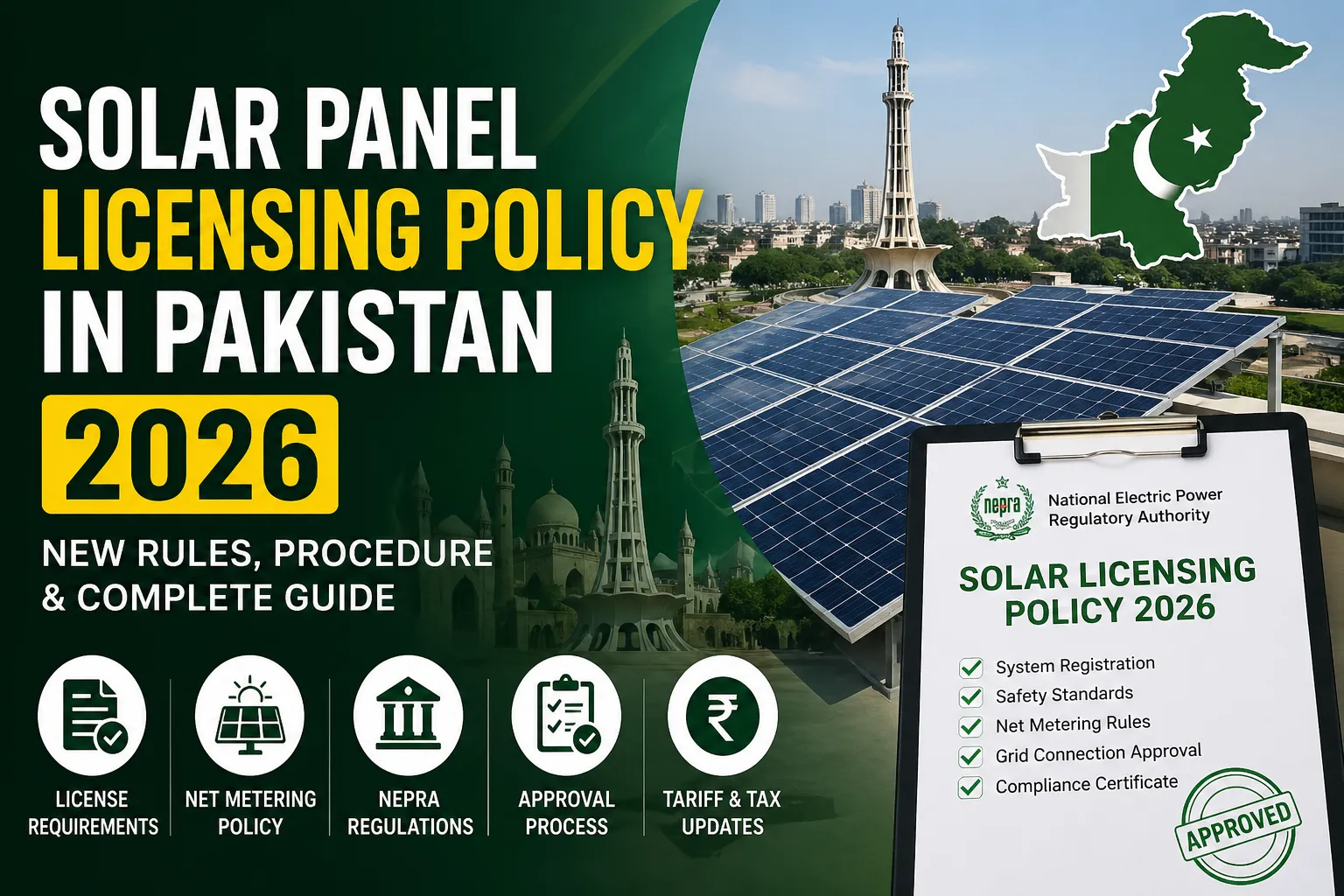
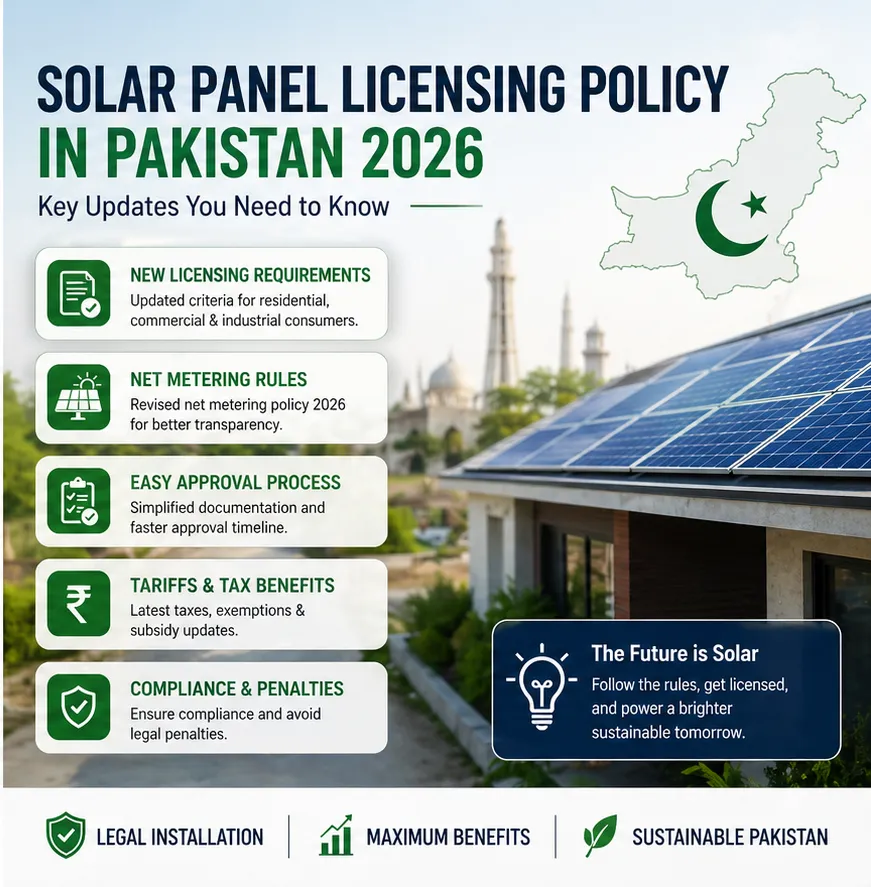
Gravity Engineering Solutions - Solar Panel Licensing Policy in Pakistan 2026

Latest Solar Panel Licensing Policy in Pakistan 2026 – Complete Guide for Homeowners & Businesses

Everything you need to know about the Solar Panel Licensing Policy in Pakistan 2026. Understand NEPRA’s new Prosumer Regulations, net billing, licensing fees, buyback rates, and how the shift from net metering affects your solar investment.

Gravity Engineering Solutions – helping you navigate the Solar Panel Licensing Policy in Pakistan 2026 with confidence.

Solar Panel Licensing Policy in Pakistan 2026 - NEPRA Prosumer Regulations

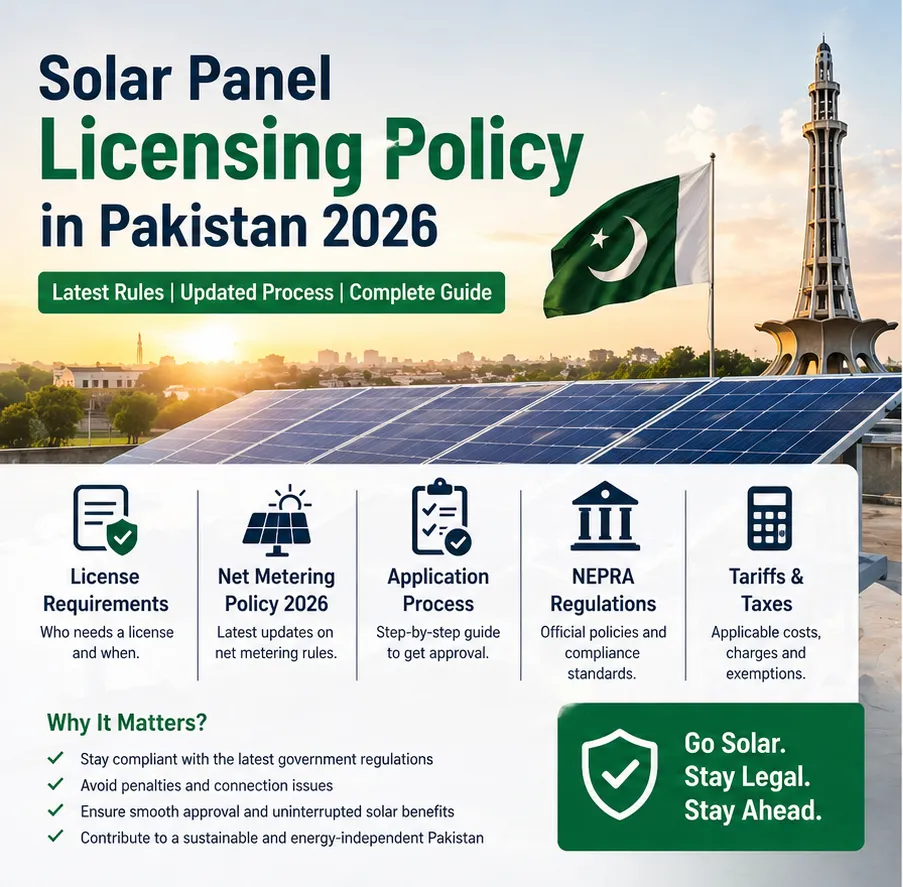
NEPRA’s Prosumer Regulations 2026 – a visual overview of the new licensing policy

Table of Contents

1. Introduction: The New Solar Panel Licensing Policy in Pakistan 2026

Official guidelines of the Solar Panel Licensing Policy in Pakistan 2026 On February 9, 2026, Pakistan’s power sector underwent a seismic shift. The National Electric Power Regulatory Authority (NEPRA) officially notified the Prosumer Regulations 2026, replacing the decade-old Net Metering Regulations 2015. This Solar Panel Licensing Policy in Pakistan 2026 affects over 466,000 existing solar users and millions of prospective ones. If you’re a homeowner, business owner, or farmer who has invested—or plans to invest—in solar energy in Pakistan, this guide is for you. We’ll walk through everything: the shift from net metering to net billing, new licensing fees, buyback rates, and what the Solar Panel Licensing Policy in Pakistan 2026 means for your electricity bill. At Gravity Engineering Solutions, we’ve helped hundreds of customers transition to solar. This guide aims to cut through the confusion and give you clear, actionable information about the Solar Panel Licensing Policy in Pakistan 2026. External resource: Download the official NEPRA Prosumer Regulations 2026 (PDF)

2. How the Solar Panel Licensing Policy in Pakistan 2026 Changes Net Metering to Net Billing

To understand the new Solar Panel Licensing Policy in Pakistan 2026, we need to understand what changed.

What Was Net Metering Under the Old Policy?

Under the old net metering system (2015-2026), solar consumers were “prosumers” – both producers and consumers. When you generated excess solar electricity, you exported it to the national grid. For every unit you exported, you received a credit of one unit that you could use later. This was a one-to-one unit exchange.

What Is Net Billing Under the New Solar Panel Licensing Policy in Pakistan 2026?

Under the new net billing system introduced by the Solar Panel Licensing Policy in Pakistan 2026, the one-to-one unit exchange is gone. Now, imported and exported electricity are valued differently. When you export electricity to the grid, you get paid a lower “buyback rate” (around Rs8–11 per unit). But when you import electricity, you still pay the full retail tariff (between Rs37 and Rs55 per unit).
Feature Net Metering (Old) Net Billing (New)
Valuation Method One-to-one unit exchange Dual valuation (buyback vs retail)
Buyback Rate (export) Rs25.9 per unit Rs8.13 – Rs11 per unit
Retail Rate (import) Same as buyback Rs37 – Rs55+ per unit
Contract Duration 7 years 5 years
Key Takeaway: Under the old system, you could offset your entire electricity bill. Under the new Solar Panel Licensing Policy in Pakistan 2026, you will always pay a significant amount to the grid because import and export rates are unequal.
External resource: Visit NEPRA’s official website for complete policy documents

3. Licensing Fees Under the Solar Panel Licensing Policy in Pakistan 2026

Another major change in the Solar Panel Licensing Policy in Pakistan 2026 is the licensing and approval process for grid-connected solar systems.

Old Process (Before February 8, 2026)

Under the 2015 regulations, systems of 25kW or less did not require a NEPRA license. Applications were processed directly by DISCOs with zero application fees.

New Fees Under the Solar Panel Licensing Policy in Pakistan 2026

The 2026 regulations have centralized the approval process. All grid-connected solar users must obtain approval from NEPRA, regardless of system size. A one-time licensing fee of Rs1,000 per kilowatt (kW) applies. For a typical 5kW system, that’s Rs5,000. Off-grid systems are completely exempt.
⚡ Important Note: NEPRA has emphasized that this fee is not a new tax. It is a one-time application processing fee for grid-connected users under the Solar Panel Licensing Policy in Pakistan 2026. Off-grid users are completely exempt.
External resource: Read Business Recorder’s analysis of the new licensing fees

4. Buyback Rates & Contract Changes in the Solar Panel Licensing Policy in Pakistan 2026

Perhaps the most impactful change in the Solar Panel Licensing Policy in Pakistan 2026 is the reduction in the buyback rate for exported solar electricity.

Reduced Buyback Rate for New Consumers

For new solar consumers (applying after February 8, 2026), the buyback rate has been slashed to approximately Rs8.13 per unit – a massive reduction from Rs25.32 per unit. The Economic Coordination Committee (ECC) has approved a revised rate of Rs10 per unit, and NEPRA will finalize the exact figure soon.
See the difference for a typical 5kW system: Under net metering (old): Export 500 units/month → Credit ~Rs12,650 against your bill. Under net billing (new): Export 500 units/month → Credit ~Rs4,000–5,000 only.

Contract Duration Reduced to 5 Years

The license validity for new solar connections under the Solar Panel Licensing Policy in Pakistan 2026 has been reduced from seven years to five years (with an option for renewal).

Protection for Existing Users

After widespread criticism, NEPRA issued a draft amendment to protect existing solar consumers. All existing net metering consumers will continue under their old billing arrangements until their contracts expire. If you submitted your application on or before February 8, 2026, you are protected under the old framework. External resource: Dawn News: Protection for existing net metering consumers

5. Who Is Affected by the Solar Panel Licensing Policy in Pakistan 2026?

Let’s break this down by category to make it crystal clear.

✅ Existing Net Metering Consumers

You are protected. Your existing contract continues under the old net metering rules. The new Solar Panel Licensing Policy in Pakistan 2026 applies only when you renew.

✅ Applications Submitted Before Feb 8, 2026

If your application was submitted on or before February 8, 2026, it will be processed under the old 2015 regulations.

❌ New Applicants (After Feb 8, 2026)

All new grid-connected solar applications fall under the new Solar Panel Licensing Policy in Pakistan 2026 with reduced buyback rates and 5-year contracts.

✅ Off-Grid Solar Users

If you are not connected to the national grid, these regulations do not apply to you. No license or fee is required.

6. Step-by-Step Application Process Under the New Policy

  1. Apply to your DISCO: Submit your application to your local Distribution Company (IESCO, LESCO, K-Electric, etc.).
  2. Technical evaluation: The DISCO evaluates whether your proposed system can be safely interconnected with the grid.
  3. System approval: If feasible, the DISCO approves your application and both parties enter into a formal agreement.
  4. NEPRA concurrence: Before electricity can be exported, NEPRA must issue formal concurrence to confirm compliance with the Solar Panel Licensing Policy in Pakistan 2026.
  5. System activation: Once NEPRA concurrence is received, your system can be activated and connected to the grid.
The entire process typically takes 2-4 weeks for residential systems.

7. How the Solar Panel Licensing Policy in Pakistan 2026 Affects Businesses

For businesses, the new Solar Panel Licensing Policy in Pakistan 2026 has profound financial implications.

Extended Payback Periods

Under net metering, commercial solar systems often paid for themselves in 2-3 years. Under net billing, with the buyback rate slashed, the payback period could extend to 5-7 years or more.

Shift in System Design Philosophy

Under the old system, businesses often sized systems to maximize export. Under the new Solar Panel Licensing Policy in Pakistan 2026, the optimal strategy is to size your system to match your daytime load as precisely as possible.
Pro Tip for Businesses: Evaluate your daytime load profile carefully. A system designed for “net zero” (generating exactly what you consume during daylight hours) will give you the best ROI under the Solar Panel Licensing Policy in Pakistan 2026.

8. Legal Challenges & Future Outlook

Constitutional Challenge Filed

RIAA Barker Gillette has filed a constitutional petition before the Islamabad High Court challenging the Solar Panel Licensing Policy in Pakistan 2026. The petition argues that the regulations fundamentally alter the compensation structure for solar consumers.

What to Watch For

  • Power Division’s Request: The government has formally asked NEPRA to scrap fees for systems under 25kW.
  • Court Decision: The constitutional challenge could result in the regulations being modified or struck down.
  • Buyback Rate Finalization: The exact buyback rate has not been formally notified.
External resource: The News International: Legal challenge against net metering changes

9. Frequently Asked Questions About the Solar Panel Licensing Policy in Pakistan 2026

Q1: I already have a net metering connection. Will my rates change under the new Solar Panel Licensing Policy in Pakistan 2026?

A: No. Existing net metering consumers are protected. You will continue under your current contract terms until they expire.

Q2: Do I need a license for an off-grid solar system?

A: No. NEPRA has clearly stated that off-grid solar systems do not require any license or fee under the Solar Panel Licensing Policy in Pakistan 2026.

Q3: How much is the licensing fee for a 5kW on-grid system?

A: The fee is Rs1,000 per kW. For a 5kW system, the one-time fee is Rs5,000 under the Solar Panel Licensing Policy in Pakistan 2026.

Q4: What is the new buyback rate?

A: For new consumers, the buyback rate has been reduced to approximately Rs8.13–11 per unit. The old rate was Rs25.9 per unit.

Q5: Is solar still worth it under the new policy?

A: Yes, but the financial model has changed. The key is to maximize self-consumption and minimize exports. Off-grid solutions are also becoming more attractive.

10. Conclusion: Navigate the Solar Panel Licensing Policy in Pakistan 2026 with Confidence

The Solar Panel Licensing Policy in Pakistan 2026 is the most significant change to Pakistan’s solar regulations in a decade. While new applicants face reduced buyback rates and licensing fees, existing users and those who applied before February 8, 2026, are protected. Whether you’re a homeowner or a business owner, understanding the Solar Panel Licensing Policy in Pakistan 2026 is the first step to making a smart solar investment. Gravity Engineering Solutions stays on top of every policy update so you don’t have to. We can help you calculate exactly how the new regulations affect your situation and design a system that maximizes your ROI.

 Key Takeaways – Solar Panel Licensing Policy 2026

✖
Net metering replaced by net billing – New applicants now get reduced buyback rates (Rs8–11/unit) instead of one‑to‑one exchange.
💰
Licensing fee of Rs1,000 per kW for grid‑connected systems (e.g., Rs5,000 for 5kW). Off‑grid systems are exempt.
📜
Contract duration reduced – Licenses valid for 5 years (down from 7 years under old policy).
🛡️
Existing users protected – Those with applications before Feb 8, 2026 continue under old net metering rules.
⚡
Self‑consumption is king – Design your system to match daytime load, not to export, for best ROI.
🔋
Off‑grid & hybrid systems (with battery storage) avoid licensing fees and low buyback rates – growing in popularity.

🌞 Gravity Engineering Solutions – Your Solar Partner in Pakistan

Expert guidance on the new policy, custom system design (on‑grid, hybrid, off‑grid), and professional installation across the country.

Visit gravitypk.com →

📞 Call/WhatsApp: +92-345-9088488 | 📧 [email protected]

Solar Panel Price Increase

Solar Panel Price Increase 2026: Urgent Update – Rates Jump to PKR 40/ Watt Before April Deadline

The solar panel price increase in 2026 has shocked buyers across Pakistan. With per-watt rates soaring from PKR 30 to PKR 40 and China’s VAT policy ending April 1, prices are set to climb further. This urgent guide from Gravity Engineering Solutions breaks down everything you need to know – and why acting now can save you lakhs.

1️⃣ Solar Panel Price Increase 2026 – What’s Happening?

If you’ve been planning to install a solar system, you may have noticed something alarming: solar panel price increase 2026 has made headlines across Pakistan. Starting January 2026, prices began climbing sharply, and the trend shows no sign of slowing down. In fact, with China’s new export policy taking effect on April 1, 2026, another wave of increases is imminent [citation:1][citation:4].

The solar panel price increase 2026 has seen per-watt rates jump from PKR 30 to PKR 40 – a staggering 33% rise in just weeks. For a standard 10kW system, this adds approximately PKR 200,000 to the total cost [citation:5][citation:6]. At Gravity Engineering Solutions, we believe in complete transparency. This guide explains every factor behind the solar panel price increase 2026 and helps you make an informed decision before costs rise further.

🚨 URGENT: China’s export VAT exemption ends April 1, 2026. Lock in today’s rates before the next price jump!

2️⃣ The Numbers: How Much Have Prices Increased?

The solar panel price increase 2026 has been dramatic and sudden. Here’s a clear comparison of before and after rates for popular Chinese A-grade panels [citation:3][citation:9].

Panel Wattage Price Before (Dec 2025) Current Price (Mar 2026) Increase
585 Watt PKR 16,000 – 17,000 PKR 20,000 – 21,000 +PKR 4,000
645 Watt PKR 20,000 PKR 24,000 – 25,000 +PKR 4,500
720 Watt PKR 22,000 – 25,000 PKR 30,000 – 35,000 +PKR 8,000 – 10,000

The solar panel price increase 2026 has affected every segment, but high-wattage panels saw the biggest absolute jumps. For buyers, this means the cost of a complete system has risen by up to PKR 200,000 [citation:6].

3️⃣ China’s April 1, 2026 Policy Shift – The Biggest Driver of Solar Panel Price Increase 2026

If you’re wondering why the solar panel price increase 2026 is accelerating, look no further than China. The world’s largest solar equipment manufacturer has announced a major policy change effective April 1, 2026 [citation:4][citation:5].

  • What’s changing? China’s Ministry of Finance is removing the export VAT exemption on photovoltaic (PV) modules entirely.
  • Impact on cost: The 9% export rebate will be gone, adding approximately 51 yuan per standard module in costs – a burden manufacturers will pass to importers like Pakistan.
  • Batteries next: Rebates on battery products will be phased out by 2027, meaning storage costs will also rise.

📢 Gravity Engineering Solutions Warning: “The April 1 policy shift will trigger another round of solar panel price increase 2026. Buyers who act before this date can lock in current rates and save 9-10% on total system cost.”

4️⃣ Per-Watt Price Trend: From PKR 22 to PKR 40 in 5 Months

The most telling metric of the solar panel price increase 2026 is the per-watt rate. According to Saleem Memon, Vice President of the Karachi Electronics Dealers Association, the per-watt cost has risen from PKR 22 to PKR 33 over five months, with predictions of reaching PKR 40 soon [citation:3].

Period Per-Watt Price (PKR) Change
October 2025 PKR 22
January 2026 PKR 30 +36%
March 2026 PKR 33 – 40 +33% (from Jan)
Post-April 2026 (Projected) PKR 40+ +9-10% more

For a 10kW system (10,000 watts), this means the panel cost alone has increased by PKR 110,000 to PKR 180,000 depending on the brand.

5️⃣ Complete Solar System Prices After the Increase

The solar panel price increase 2026 has directly impacted complete system costs. Here are the latest on-grid system rates across Pakistan [citation:2][citation:7].

System Size Price (On-Grid, Without Battery) Increase vs 2025
3 kW PKR 330,000 – 380,000 +PKR 50,000 – 80,000
5 kW PKR 580,000 – 650,000 +PKR 100,000 – 150,000
7 kW PKR 750,000 +PKR 120,000
10 kW PKR 850,000 – 1,100,000 +PKR 150,000 – 200,000
12 kW PKR 1,250,000 +PKR 200,000
15 kW PKR 1,500,000 +PKR 250,000

Hybrid systems with batteries cost additional PKR 200,000 to PKR 500,000 depending on battery technology and capacity.

6️⃣ Solar Battery Prices Also Rise – 10% Hike Confirmed

The solar panel price increase 2026 isn’t limited to panels. Battery prices have also climbed by approximately 10% over the past month [citation:1][citation:3].

  • Lead-acid batteries: Prices up due to rising lead costs.
  • Lithium-ion batteries: Under pressure from global lithium and cobalt prices, plus China’s phased battery rebate removal by 2027.

For hybrid system buyers, this means the total cost of a complete solar setup has increased by even more than panel prices alone would suggest. Gravity Engineering Solutions recommends factoring battery costs into your budget if you require backup power.

7️⃣ Why Are Solar Panel Prices Increasing in Pakistan?

Multiple factors are driving the solar panel price increase 2026. Here’s a breakdown [citation:8]:

🌍 Global Raw Material Costs

Silver and copper prices have hit record highs. These metals are essential for solar cell production. When raw material costs rise, manufacturers increase prices, and those increases reach Pakistani buyers.

📈 Strong Local Demand

Electricity tariffs remain high, and load shedding continues. Demand for solar systems has stayed strong, creating upward pressure on prices even before global factors are considered.

🏷️ Import Duties & Currency Pressure

Taxes on Chinese solar panel imports have increased, and a weaker rupee makes imported equipment more expensive.

🇨🇳 China’s Policy Shift (April 1)

As detailed above, the removal of export VAT exemptions will add another 9-10% to module costs.

8️⃣ Net Metering vs Net Billing – Policy Context for 2026

The solar panel price increase 2026 comes alongside changes to how solar users are compensated for excess energy. In December 2025, NEPRA approved new Prosumer Regulations, moving from net metering to net billing for new applicants [citation:2].

Feature Old Net Metering New Net Billing
Buyback Rate ~PKR 27/unit PKR 11/unit
License Duration 7 years 5 years
System Size Limit Flexible Limited to sanctioned load

Existing net metering consumers are protected under old rules until their contracts expire. However, new buyers should factor the reduced buyback rate into their ROI calculations. Even with the lower rate, solar remains highly profitable due to high displacement savings (PKR 35-45/unit saved).

9️⃣ Expert Voice: What Importers Say About the Solar Panel Price Increase 2026

Saleem Memon, Vice President of the Karachi Electronics Dealers Association and a solar panel importer, shared his insights on the solar panel price increase 2026 [citation:9]:

“Higher silver and copper prices have pushed up production expenses for Chinese manufacturers. The per-watt cost has increased from PKR 22 to PKR 33 over the past five months. Strong local demand, combined with further price increases in China, could lift the per-watt rate to PKR 40 in the coming months.”

Memon also noted that Pakistan still holds large inventories from high imports over the past two years, which may temporarily ease the pressure – but the April 1 policy shift will eventually impact all buyers.

🔟 What Buyers Should Do Before Prices Rise Further

Despite the solar panel price increase 2026, solar energy remains a smart long-term investment. Here’s how to navigate the current market [citation:8].

✅ Lock in Rates Before April 1, 2026

With China’s VAT exemption ending, another price jump is imminent. Buyers who finalize their purchase now can avoid the 9-10% increase expected after April.

✅ Compare Multiple Vendors

Prices vary by brand, warranty, and seller. Request quotes from multiple EPC contractors, but beware of unusually low quotes that may use lower-quality panels.

✅ Focus on System Efficiency

Instead of buying more panels, consider energy-efficient appliances and load management. Reducing consumption can lower the required system size and total cost.

✅ Choose Tier-1 Components

A slightly higher upfront cost for Jinko, Longi, or Canadian Solar panels pays off with 25-30 year performance warranties.

🔰 Ready to Beat the Price Increase?

Lock in today’s rates with Gravity Engineering Solutions. We’ll help you design and install a future-proof system before prices rise again.

Request Your Free Estimate →

Or contact our solar experts directly

1️⃣1️⃣ Frequently Asked Questions on Solar Panel Price Increase 2026

Q1: Why is there a solar panel price increase in 2026?

A: The increase is driven by rising global raw material costs (silver, copper), strong local demand, import duties, currency pressure, and China’s upcoming removal of export VAT exemptions on April 1, 2026 [citation:4].

Q2: How much have solar panel prices increased in 2026?

A: Per-watt rates have jumped from PKR 30 to PKR 40 – a 33% increase. For a 10kW system, this adds approximately PKR 200,000 to the total cost [citation:7].

Q3: Will solar panel prices go down again?

A: Experts predict further increases, especially after April 1, 2026. A return to 2025 price levels is unlikely in the short term [citation:8].

Q4: Is solar still worth it despite the price increase?

A: Yes. Grid electricity tariffs are also rising (15-20% annually). The payback period remains attractive (2-4 years), and systems last 25+ years. Solar protects you from future tariff hikes.

Q5: How can I avoid the upcoming price increase?

A: Finalize your purchase before April 1, 2026. Contact Gravity Engineering Solutions to lock in current rates and secure your system before the next price jump.

1️⃣2️⃣ Conclusion – Act Now Before the Solar Panel Price Increase 2026 Hits Harder

The solar panel price increase 2026 has already added thousands to system costs, and the worst may be yet to come. With China’s VAT exemption ending April 1, another 9-10% hike is expected. For buyers, this means a 10kW system that cost PKR 1,000,000 in 2025 could cost PKR 1,300,000 or more by mid-2026.

However, even with higher upfront costs, solar remains a wise investment. Electricity tariffs are projected to rise further, and load shedding continues. By installing now, you lock in today’s rates and protect yourself from future increases.

Gravity Engineering Solutions is here to help. With our expertise in solar design, installation, and net metering approvals, we ensure you get the best value for your investment. Contact us today before the next price wave hits.

⏰ Countdown to April 1 Price Increase

Secure current rates – Request your free estimate today!

Get Your Free Estimate →

Contact Gravity Engineering Solutions →

The Engineering Team at Gravity Engineering Solutions – Pakistan’s leading solar EPC company. This guide is based on real-time market data, expert interviews, and official policy announcements.

Sources: Energy Update, Pakistan Observer, TechJuice, GTV News, Daily Ausaf, InfraEnergy.pk (March 2026). All information verified and updated.

Solar Panel Price

⚡ Solar Panel Price in Pakistan 2026: Complete Guide & Updated Costs (March–April Update)

Discover the latest solar panel price in Pakistan for 2026, brought to you by Gravity Engineering Solutions – your trusted partner for turnkey solar installations. We provide a granular breakdown of per‑watt rates, complete system costs (3kW to 15kW), battery prices, brand comparisons, and expert analysis on the recent solar panel price surge. Fully optimized for residential, commercial, and industrial buyers.

1️⃣ Introduction – Why Solar Panel Prices Are Rising in Pakistan (2026)

The year 2026 began with a seismic shift in Pakistan’s solar energy market. After months of relative stability, solar panel price in Pakistan witnessed an abrupt and sharp increase, leaving consumers, installers, and industrial buyers recalibrating their budgets. As electricity tariffs continue to climb and load shedding persists, solar energy remains the most viable long-term solution. However, understanding the new solar panel price dynamics is crucial.

At Gravity Engineering Solutions, we’ve been closely monitoring these changes. According to our market intelligence and daily interaction with suppliers, the per-watt solar panel price has surged from PKR 30 to PKR 40 – a staggering 33% increase in a matter of weeks. This comprehensive guide dissects every aspect of these changes. We will explore not only the current solar panel price in Pakistan but also the underlying causes—from global raw material inflation (silver, copper, polysilicon) to China’s upcoming export policy changes. Whether you are a homeowner looking for a 5kW system or an industrialist planning a megawatt-scale installation, this 8000-word guide serves as your definitive resource.

2️⃣ Current Solar Panel Price in Pakistan – Per Watt & Individual Panel Rates

As of March 2026, the solar panel price in Pakistan has settled at a new normal following the January surge. The table below illustrates the dramatic increase witnessed across popular wattages.

Panel WattageOld Price (Dec 2025)New Price (Jan–Mar 2026)Increase
585 WattPKR 16,000 – 17,000PKR 20,000 – 21,000+PKR 4,000
645 WattPKR 20,000PKR 24,000 – 25,000+PKR 4,500
720 WattPKR 22,000 – 25,000PKR 30,000 – 35,000+PKR 8,000 – 10,000

*Prices are for imported Chinese A-grade panels in major cities (Karachi, Lahore, Islamabad). Source: Gravity Engineering Solutions market analysis.

📊 Per-Watt Price Trend

Industry sources confirm that the average solar panel price in Pakistan per watt has escalated from PKR 22 five months ago to PKR 33 today, with predictions of hitting PKR 40 by mid-2026. This is driven by a perfect storm of rising silver and copper prices globally, as these materials are essential for photovoltaic cell production. The solar panel price volatility is further fueled by high domestic demand and supply chain disruptions.

📈 Key Insight: The per-watt rate is the most critical metric. Always calculate total cost as: Panel Wattage × Per Watt Rate = Panel Price. With the new solar panel price at PKR 33-40/W, a 10kW system (10,000 watts) now costs significantly more in just panels alone.

3️⃣ Complete Solar System Prices (3kW, 5kW, 10kW, 15kW) With/Without Battery

For most consumers, the solar panel price is just one component. The complete installed system cost, including inverter, structure, wiring, and batteries, is what matters. Below are the latest rates published in January 2026 and validated by Gravity Engineering Solutions.

🔹 On-Grid (Grid-Tied) System Prices

System SizePrice (Without Battery)Notes
3 kWPKR 330,000 – 380,000Ideal for small homes
5 kWPKR 580,000 – 650,000Most popular residential size
7 kWPKR 750,000Medium homes/small offices
10 kWPKR 850,000 – 1,100,000Large homes / small commercial
12 kWPKR 1,250,000Commercial
15 kWPKR 1,500,000Large commercial

🔹 Hybrid (With Battery Backup) System Prices

System SizePrice Range (With Battery)
3 kWPKR 400,000 – 450,000
5 kWPKR 775,000 – 850,000
10 kWPKR 1,300,000 – 3,000,000*
20 kWPKR 2,100,000 – 2,300,000

*10kW hybrid prices vary widely based on battery capacity (lithium vs lead-acid).

🚨 Important: The recent PKR 10 per watt increase in solar panel price has added approximately PKR 200,000 to the cost of a full 10kW system. Factor this into your budget.

4️⃣ A-Grade Solar Panel Brand Price Comparison (Jinko, Longi, Canadian, Trina)

Not all panels are equal. Tier-1 brands command a premium but offer better efficiency and longer warranties. Here are the latest solar panel price in Pakistan for leading international brands, as reported in January 2026.

Brand & ModelTypePrice (PKR/Watt)
Jinko N-type BifacialBifacial N-TypePKR 29.50
Astro Energy BifacialBifacialPKR 28.50
Longi Himo 7 N-Type BifacialBifacial N-TypePKR 31.25
Trina N-type MonocrystallineMono N-TypePKR 28.65
Canadian Topcon (585W)TopconPKR 31.80
Jinko N-Type MonofacialMono N-TypePKR 31.75
Q-Super A-Grade BifacialBifacialPKR 28.00
Longi Himo 10X HPBC 2.0HPBCPKR 33.00

Note: These are per-watt rates for the panels only, excluding inverters and installation.

The premium for cutting-edge technology like HPBC (Hybrid Passivated Back Contact) and Topcon is evident. For most residential applications, Jinko and Longi remain the gold standard, balancing cost and reliability. Gravity Engineering Solutions only sources A‑grade panels from these trusted manufacturers to guarantee performance and longevity. When comparing solar panel price across brands, always consider the efficiency and warranty terms, not just the upfront cost.

5️⃣ China Export Policy Shift (April 2026) – Future Price Impact

A monumental policy change is on the horizon. China’s Ministry of Finance and State Taxation Administration has announced the withdrawal of export VAT exemptions on photovoltaic products, effective April 1, 2026.

  • What’s changing? The export rebate on PV modules will be completely removed. Rebates on battery products will be phased out by 2027.
  • Impact: Removing the 9% rebate will increase module costs proportionally. Analysts predict a reduction in export profits by up to 51 yuan per standard module, a cost likely passed on to importers.
  • Pakistan Specific: Since Pakistan imports the vast majority of its solar panels from China, the solar panel price in Pakistan is expected to rise further post‑April 2026.
📢 Gravity Engineering Solutions Advises: “If you are planning a solar installation, consider completing your purchase before April 2026 to avoid the anticipated 9‑10% hike in solar panel price due to China’s VAT policy change. Submit an estimate request now to lock in current rates.”

External Reference: For official details, read the China Ministry of Finance announcement and the NEPRA regulatory updates on import policies.

6️⃣ Solar Battery Prices in Pakistan – 10% Hike Explained

It’s not just panels. The cost of energy storage has also climbed. In the last month alone, solar battery prices have increased by approximately 10%.

  • Lead-Acid Batteries: Widely used but heavier and with shorter lifespan. Prices have increased due to rising lead costs.
  • Lithium-Ion Batteries: Becoming the preferred choice for hybrid systems. Their prices are also under upward pressure due to global raw material inflation (lithium, cobalt).

For a typical 5kW hybrid system, the battery bank cost can now range from PKR 200,000 to over PKR 500,000 depending on technology and capacity. Always factor battery replacement into your long‑term ROI calculations. The rising solar panel price combined with battery cost increases makes it essential to get a comprehensive quote from a reliable EPC.

7️⃣ Net Metering vs Net Billing 2026 – New Regulations

The regulatory landscape has shifted. In December 2025, NEPRA approved new “Prosumer Regulations,” moving from net metering to a net billing model for new applicants.

FeatureOld Net Metering (Pre-2026)New Net Billing (2026 onward)
Buyback Rate~PKR 27/unit (retail rate)PKR 11/unit (reduced)
System Size LimitFlexibleLimited to sanctioned load
License Duration7 years5 years
RequirementSimplerLicense required for systems up to 25kW

Impact on Solar Panel Price ROI: With a lower buyback rate, the financial payback period for on‑grid systems may extend slightly. However, given the high displacement value (saving PKR 35‑45/unit you would otherwise pay to the grid), solar remains highly lucrative. Existing net metering consumers are protected under old rules until their contract expires. For the latest NEPRA guidelines, visit the official NEPRA website.

8️⃣ Government Solar Schemes – KP 2kW System Payment Plan

To offset rising solar panel price concerns, the Khyber Pakhtunkhwa government launched a massive initiative for 120,000 families in January 2026.

  • System: 2kW solar system with inverter and essential components.
  • Value: PKR 255,000 – 300,000 per system (fully funded by government).
  • Districts: Bajaur, Khyber, Kurram, Orakzai, Mohmand, North/South Waziristan.
  • Payment Plan: Refundable option: PKR 8,300/month for 36 months. Non‑refundable option for vulnerable households at no upfront cost.

This scheme significantly reduces the effective solar panel price for eligible families, making clean energy accessible. Other provinces may announce similar programs as 2026 progresses. Read more about the program at the KP Government official portal.

9️⃣ Return on Investment (ROI) & Payback Period Calculator

Despite higher upfront costs due to increased solar panel price, the ROI for solar in Pakistan remains compelling. Here’s a sample calculation for a 10kW on‑grid system.

  • System Cost: PKR 1,000,000 (approx).
  • Average Daily Generation: 40‑45 kWh (units).
  • Annual Generation: ~15,000 kWh.
  • Displaced Grid Cost: Assume PKR 45/unit (average commercial rate).
  • Annual Savings: 15,000 × 45 = PKR 675,000.
  • Payback Period: PKR 1,000,000 / PKR 675,000 ≈ 1.5 years.

Even with net billing (PKR 11/unit export), the savings from self‑consumption drive the ROI. Over a 25‑year lifespan, the net savings are in the millions. For global context, check the IEA Solar PV report and World Bank solar outlook.

Financing Options & Long-Term Value: Why the Solar Panel Price Is Just the Beginning

When evaluating the solar panel price in Pakistan, many consumers focus solely on the upfront cost. However, understanding financing options, warranty structures, and long-term operational expenses can make a significant difference in your overall return on investment. In this section, we break down the hidden factors that influence the true cost of going solar and why the initial solar panel price in pakistan is only part of the story.

Financing Models Available in Pakistan

With the recent spike in solar panel price, many homeowners and businesses are exploring financing options to ease the burden. Banks like Bank Alfalah, HBL, and Meezan Bank now offer solar financing with mark-up rates as low as 5-8% per annum. These loans typically cover the full system cost, including installation, and allow you to pay back over 3-7 years. By financing, you can lock in the current solar panel price before the anticipated post-April increase, while using the monthly savings from reduced electricity bills to service the loan. Some financial institutions even offer deferred first payment options, making it easier to manage cash flow.

Additionally, many EPC companies—including Gravity Engineering Solutions—provide in-house installment plans. These plans are designed to help you spread the cost without involving a bank. When comparing these options, it’s important to factor in the total financed cost versus the upfront solar panel price. A slightly higher financed amount may be worth it if it allows you to start saving immediately.

Warranty: The True Value Behind the Solar Panel Price

Not all panels are created equal, and the solar panel price often reflects the warranty coverage. Tier‑1 brands like Jinko, Longi, and Canadian Solar offer product warranties of 12‑15 years and performance warranties of 25‑30 years (guaranteeing at least 80‑85% output after 25 years). In contrast, cheaper panels may carry shorter warranties and degrade faster. When you see a significantly lower solar panel price, it’s crucial to verify the warranty terms. A panel that fails after 10 years will wipe out your savings, making the initially cheaper solar panel price far more expensive in the long run.

At Gravity Engineering Solutions, we only install panels with comprehensive warranties. We also back our work with a 5‑year installation warranty, ensuring any workmanship issues are covered. This peace of mind is an often-overlooked component of the overall investment.

Hidden Costs: What’s Not Included in the Solar Panel Price?

Many quotes focus only on the solar panel price and inverter cost, leaving out essential components that can add 15‑20% to the final bill. These include:

  • Mounting structures: A robust, galvanized iron structure suitable for Pakistan’s wind and weather conditions can add PKR 4‑6 per watt.
  • Cabling and protection: DC and AC cables, circuit breakers, surge protection devices, and earthing systems.
  • Net metering application fees: DISCOs charge a fee for processing and installing the bidirectional meter.
  • Transportation and logistics: Especially for industrial systems where heavy panels and structures need to be moved to remote locations.

A professional EPC like Gravity Engineering Solutions provides an all‑inclusive quote that itemizes these costs. When comparing solar panel price across vendors, always ask for a complete breakdown to avoid unpleasant surprises.

 The Impact of Inflation on Solar Panel Price and Electricity Tariffs

Pakistan’s economy has experienced high inflation, and the energy sector is no exception. Over the past three years, electricity tariffs have increased by an average of 15‑20% annually. In contrast, the solar panel price has historically trended downward, but the recent surge is a temporary correction. By installing solar now, you effectively lock in your energy cost at today’s solar panel price and protect yourself from future tariff hikes. The table below illustrates the escalating grid rates compared to a fixed solar investment:

YearAverage Grid Tariff (PKR/kWh)Solar LCOE (PKR/kWh)*
20232812
20253812
2026 (projected)45+12

*Levelized cost of electricity (LCOE) based on current solar panel price and system lifespan.

As you can see, the gap widens every year, making the decision to install solar increasingly financially attractive.

Why Waiting Could Cost You More

With the China VAT exemption removal set for April 1, 2026, and ongoing global raw material inflation, the solar panel price is likely to climb another 9‑12% by mid‑2026. Furthermore, the new net billing regulations already reduce the buyback rate, meaning the value of exported energy has decreased. For those who install now, they still benefit from the old net metering rules (if already connected) and lock in a lower solar panel price. Every month you delay, you not only miss out on thousands of rupees in savings but also risk paying a significantly higher solar panel price.

Gravity Engineering Solutions has observed that many customers who postponed their decision in 2025 are now facing a 30‑40% higher solar panel price in 2026. Don’t let that be your story. Act before the April deadline to secure today’s rates.

💡 Pro Tip from Gravity Engineering Solutions:

Use our free estimate request tool to get a comprehensive quote that includes all costs, financing options, and a detailed breakdown of the solar panel price for your specific load. Our experts will help you design a system that maximizes savings while staying within your budget.

In summary, the advertised solar panel price is just the tip of the iceberg. By considering financing, warranty, hidden costs, and future tariff trends, you can make an informed decision that delivers decades of clean, affordable energy. Gravity Engineering Solutions is here to guide you through every step, ensuring that your investment is sound and your system performs optimally for years to come.

🔟 Why Choose Gravity Engineering Solutions for Your Solar Installation?

The solar panel price is only part of the equation. Poor installation can reduce efficiency by 20% or more. At Gravity Engineering Solutions, we don’t just sell panels; we deliver complete, worry‑free solar systems. Here’s what sets us apart:

  • End‑to‑End EPC Services: From site survey and shade analysis to structural mounting, inverter selection, and commissioning – we handle everything.
  • Net Metering Expertise: Our team navigates the complex DISCO approvals, ensuring you get your net metering (or net billing) license without delays.
  • Premium Components Only: We use Tier‑1 panels (Jinko, Longi, Canadian Solar) and top inverters (Huawei, Sungrow, GoodWe) to guarantee long‑term performance.
  • Transparent Pricing: No hidden costs. We provide itemized quotes so you know exactly what you’re paying for, including the latest solar panel price breakdown.
  • After‑Sales Support: 24/7 monitoring and prompt service ensure your system keeps generating maximum savings.

Ready to beat the upcoming price hike? Request a free estimate here or contact our expert team for a personalized consultation.

1️⃣1️⃣ Frequently Asked Questions (FAQ) on Solar Panel Price

Q1: What is the current solar panel price per watt in Pakistan?

A: As of March 2026, the per‑watt solar panel price ranges from PKR 33 to PKR 40, depending on the brand and technology. This is up from PKR 22‑30 just a few months ago.

Q2: Why did solar panel prices increase suddenly?

A: The primary reasons are: 1) Global increase in raw material costs (silver, copper, polysilicon). 2) High demand in Pakistan. 3) Import duties. 4) Anticipation of China’s VAT rebate removal.

Q3: Will solar panel prices decrease in the future?

A: Unfortunately, experts predict further increases, especially after April 2026 when China’s export policy takes effect. A decrease is unlikely in the short term.

Q4: Is solar still worth it with the price hike?

A: Absolutely. Despite higher upfront solar panel price, grid electricity tariffs are also rising. The payback period remains attractive (2‑4 years), and systems last 25+ years.

Q5: What is the best solar panel brand in Pakistan?

A: Jinko, Longi, Canadian Solar, and Trina are top‑tier brands with proven performance in Pakistan’s climate. Gravity Engineering Solutions can help you choose the right one for your budget.

Q6: How do I get a reliable solar quote?

A: Simply fill out the estimate request form or contact our team. We’ll assess your load, design the system, and provide a fixed‑price quote with no surprises, reflecting the current solar panel price.

1️⃣2️⃣ Conclusion – Is 2026 a Good Time to Invest?

The solar panel price in Pakistan landscape has fundamentally shifted in early 2026. Prices are at their highest in recent memory, with a strong likelihood of further increases post‑April due to China’s policy change. For consumers, this creates a classic “buy before it gets more expensive” scenario. Delaying a solar installation means facing even higher solar panel price later, while continuing to pay escalating electricity bills.

For commercial and industrial entities, the case for solar is stronger than ever. With payback periods as short as 1.5 to 3 years, the investment shields your business from future tariff hikes and provides energy independence. We recommend obtaining quotes from multiple reputable EPC contractors, focusing on Tier‑1 components, and initiating projects before the mid‑2026 price wave.

🔰 Ready to Secure the Current Solar Panel Price?

Let Gravity Engineering Solutions help you design and install a future‑proof solar system before prices rise again.

Get Your Free Estimate →

Or contact our solar experts directly.

The Engineering Team at Gravity Engineering Solutions – Pakistan’s leading solar EPC company with over 500 successful installations. This guide is based on real‑time market data and our decade of industry experience.

Last updated: March 2026 | All prices are indicative and subject to change. Request a personalized quote for the most current solar panel price.

Solar System Installation in Pakistan (5kW to 1MW+) 

Energy in Pakistan is no longer just a utility bill. It is a balance sheet variable, a production risk, and a competitive advantage — or a silent liability.

From Islamabad’s residential expansions to Lahore’s industrial corridors and Karachi’s commercial high-rises, electricity instability and tariff escalation are reshaping financial planning across every sector.

The solution is not simply “installing solar panels.” The solution is engineered solar energy infrastructure designed for scale, resilience, and maximum ROI.

Gravity Engineering Solutions develops and executes solar systems ranging from 5kW residential installations to 1MW+ industrial EPC solar power plants, fully integrated with advanced Battery Energy Storage Systems (BESS).

This guide is the definitive 2026 blueprint for solar system installation in Pakistan.


Pakistan’s Energy Reality – Solar is No Longer Optional

Electricity tariffs in Pakistan have steadily increased over the past decade. Industrial operators in Lahore report margin pressure directly tied to energy volatility. Commercial property owners in Karachi face high peak demand charges, while Islamabad residents encounter seasonal tariff spikes.

At the same time, Pakistan receives exceptional solar irradiation — among the strongest in South Asia.

Global data from the International Energy Agency (IEA) shows that decentralized solar generation combined with storage is one of the most financially resilient infrastructure investments in emerging markets.

Locally, net metering regulations enforced by the National Electric Power Regulatory Authority (NEPRA) are accelerating distributed solar adoption.

Economics are simple:

  • Grid electricity = recurring liability
  • Engineered solar + BESS = capital asset

By 2026, businesses are investing in assets, not liabilities.


Engineering vs Basic Installation – The Hidden Performance Gap

The Pakistani solar market is crowded. Most companies install equipment; few engineer energy systems.

An engineered solar project includes:

  • Load curve analytics (hour-by-hour demand modeling)
  • Harmonic distortion assessment
  • Transformer compatibility analysis
  • Wind-load & structural integrity modeling
  • Protection relay coordination
  • SCADA performance monitoring integration
  • Battery discharge-cycle optimization (for BESS)

Without engineering, projected ROI rarely matches actual performance.

Gravity Engineering Solutions operates at EPC level — Engineering, Procurement & Construction — ensuring calculated performance.

View Our EPC Solar Capabilities


Solar Capacity Architecture – From 5kW Homes to 1MW Industrial Power Plants

Capacity is not just about size; it is about design intent.

5kW Solar Systems – Residential Autonomy

Optimized for modern households with air conditioning and daytime loads.

10kW–15kW Systems – Premium Residential & Small Enterprises

Supports higher loads and optional lithium BESS integration.

20kW–100kW Systems – Commercial Infrastructure

Designed for corporate offices, educational institutions, healthcare facilities, and retail plazas.

250kW–500kW Systems – Industrial Mid-Scale Power

Common for textile units, cold storages, and warehouses.

1MW+ Solar Plants – Industrial Energy Transformation

Large-scale solar infrastructure integrated with high-voltage grid synchronization and optional BESS for peak stabilization.


BESS Foundation – Storage is the Future of Energy Control

Solar generates energy; BESS controls it. In Pakistan’s evolving grid, storage is essential.

  • Peak load shaving
  • Outage immunity
  • Tariff arbitrage
  • Demand charge reduction
  • Grid frequency stabilization

For factories in Karachi, BESS eliminates downtime risk. For commercial plazas in Lahore, it reduces peak penalties. For residential clients in Islamabad, it provides uninterrupted backup.

Explore Our BESS & Power Backup Solutions

Residential Solar Systems (5kW–15kW) – Engineering Smart Independence

In Islamabad, Rawalpindi, and other major cities, residential solar adoption is no longer a trend; it is a long-term financial hedge. Gravity Engineering Solutions designs each 5kW to 15kW solar system based on actual household load curves, ensuring maximum energy efficiency and ROI.

Key Engineering Considerations:

  • Daytime vs nighttime consumption analysis
  • Inverter load tolerance margin
  • Roof tilt optimization for annual solar yield
  • Net metering export capacity compliance
  • Optional lithium BESS sizing for evening energy autonomy

With rising electricity tariffs, professionally engineered residential solar systems typically achieve payback within 3–5 years. Panel lifespans exceed 25 years, providing decades of financial and energy security.

Explore Residential Solar Solutions


Commercial Solar Infrastructure (20kW–250kW) – Operational Cost Optimization

Commercial buildings operate primarily during peak daylight hours — exactly when solar energy generation is strongest. Aligning consumption with production creates maximum financial leverage.

For commercial properties in Lahore, Karachi, and Sargodha, engineered solar systems reduce daytime tariffs and lower demand charges. Paired with BESS, facilities can discharge stored power strategically, minimizing peak-hour energy costs.

Strategic Advantages:

  • Direct peak-hour cost reduction
  • Lower operational volatility
  • Brand sustainability positioning
  • Improved asset valuation
  • Enhanced ESG compliance for corporate reporting

Gravity Engineering Solutions delivers complete commercial solar solutions including system design, installation, BESS integration, and long-term maintenance.

View Our Commercial Solar Projects


Residential Solar Case Study – Islamabad 10kW System

System Size: 10kW On-Grid Hybrid
Annual Generation: Optimized for Islamabad solar irradiation
BESS Integration: 10kWh Lithium Battery (optional)

Impact:

  • 80% daytime grid offset
  • Net metering export credit applied
  • Payback: 3–4 years
  • 25-year lifecycle savings: Substantial reduction in household energy expenses
  • Energy autonomy during peak tariff periods

These results highlight why residential solar is rapidly becoming a capital asset rather than just an energy solution.


Commercial Solar Case Study – Lahore Office Plaza 100kW

Peak Daytime Consumption: High business-hour load
Tariff Class: Commercial
BESS Integration: 50kWh for peak shaving and demand management

Financial Effects:

  • Peak-hour energy offset reduces operating costs
  • Maximum demand reduction achieved via BESS
  • Capital recovery within 2–4 years
  • Improved commercial property valuation and sustainability branding

Strategic deployment of solar + BESS aligns energy supply with demand, increasing operational efficiency and financial predictability.


Get Started – Residential & Commercial Solar Engineering

Whether you are a homeowner in Islamabad or managing a commercial facility in Lahore or Karachi, Gravity Engineering Solutions provides:

  • Load analysis & system sizing
  • Professional EPC solar installation
  • Battery storage integration
  • Net metering application support
  • Long-term monitoring & maintenance

Request Your Free Residential/Commercial Solar Consultation

Serving Islamabad | Rawalpindi | Lahore | Karachi | Sargodha | Peshawar | Nationwide Pakistan

Industrial & EPC Solar Projects (500kW–1MW+) – Infrastructure-Grade Engineering

Industrial solar systems are not simply scaled-up residential setups. They are fully integrated, high-capacity energy infrastructures designed for operational continuity and financial optimization.

Gravity Engineering Solutions executes comprehensive EPC projects, including:

  1. Full energy audit & load profiling
  2. Transformer capacity evaluation
  3. Short-circuit & protection relay coordination study
  4. High-voltage interconnection design
  5. SCADA monitoring & remote diagnostics
  6. Commissioning & performance benchmarking

For industrial facilities in Lahore, Karachi, and Sargodha, 1MW+ solar plants significantly reduce long-term energy costs, stabilize production, and enhance competitiveness.

View Industrial Solar EPC Projects


Net Metering in Pakistan – Step-by-Step Regulatory Process

Net metering allows solar system owners to export surplus electricity to the grid, creating additional financial benefits. The process is regulated by the National Electric Power Regulatory Authority (NEPRA) and local DISCOs.

Approval Process Overview:

  1. System design submission to DISCO
  2. Load verification by DISCO engineers
  3. Technical inspection of panels and inverters
  4. Bi-directional meter installation
  5. Operational approval and grid synchronization

Professional documentation and compliance with Gravity Engineering Solutions’ EPC standards accelerate approval and reduce delays.


Advanced BESS Architecture – Lithium, LFP & Industrial Storage

Battery Energy Storage Systems (BESS) are transforming Pakistan’s solar industry. Solar generates energy; BESS controls, stores, and optimizes it for peak performance.

Primary Battery Technologies:

1. Lithium-Ion (NMC)

  • High energy density for space-constrained installations
  • Compact footprint ideal for commercial facilities
  • Rapid charge-discharge capability

2. Lithium Iron Phosphate (LFP)

  • Superior thermal stability and safety
  • Extended cycle life for industrial applications
  • Optimal for large-scale energy storage integration

Industrial BESS Applications:

  • Peak load shaving and tariff reduction
  • Demand charge management
  • Emergency backup during grid outages
  • Grid frequency stabilization
  • Hybrid solar system integration for maximum ROI

In Karachi and Lahore industrial zones, BESS integration ensures zero downtime and energy cost predictability. Explore Our BESS & Backup Solutions


Industrial Case Study – 1MW Solar Plant Transformation

Consider a Karachi manufacturing facility operating 24/7:

Without solar:

  • High peak-hour tariff exposure
  • Production cost variability due to grid outages
  • Inflation-linked energy risk

With 1MW solar + engineered BESS:

  • Majority daytime load offset by solar
  • Peak shaving and demand control via BESS
  • Reduced exposure to tariff inflation
  • Enhanced production stability
  • Payback within 2–3 years depending on load profile

This industrial solar infrastructure converts recurring energy costs into predictable, capitalized assets, transforming cost structures and competitiveness.


Get Started – Industrial & EPC Solar Projects

For industrial facilities seeking 500kW–1MW+ solar plants with advanced BESS integration, Gravity Engineering Solutions offers:

  • Full EPC project execution
  • High-voltage grid synchronization
  • SCADA monitoring & remote diagnostics
  • Battery storage & hybrid solar engineering
  • Regulatory compliance and net metering support
  • Ongoing maintenance & performance optimization

Book Your Free Industrial Solar Consultation

Serving Lahore | Karachi | Sargodha | Islamabad | Rawalpindi | Peshawar | Nationwide Pakistan

City-Specific Solar System Installation & Strategy Across Pakistan

Islamabad – Residential & High-End Adoption

Islamabad boasts high residential solar penetration. 5kW–15kW systems with hybrid lithium BESS are increasingly preferred for energy autonomy and net metering credits. Gravity Engineering Solutions provides turnkey residential solutions optimized for household load curves.

Rawalpindi – Mid-Scale Commercial Growth

Rawalpindi shows growing demand for 20kW–100kW commercial solar systems. Small industries, office complexes, and retail plazas reduce daytime tariff exposure through engineered solar + BESS integration.

Lahore – Industrial & Large-Scale EPC Projects

Lahore’s industrial zones drive large-scale EPC demand. Textile mills, factories, and warehouses deploy 500kW–1MW+ solar plants to manage costs and protect margins. Gravity Engineering Solutions ensures full EPC delivery with grid synchronization and SCADA monitoring.

Karachi – Commercial & Industrial BESS Integration

Karachi represents the most dynamic solar + BESS market. Frequent grid fluctuations and high daytime tariffs necessitate 250kW–1MW hybrid solar projects. Industrial-grade BESS ensures zero downtime for critical operations.

Sargodha – Agricultural & Processing Solar Adoption

Mid-scale solar adoption in agriculture and cold storage is rising. Gravity Engineering Solutions customizes 50kW–250kW systems for farming, processing, and storage facilities.

Peshawar – Reliability-Focused Hybrid Systems

Hybrid solar systems dominate demand in Peshawar due to reliability concerns. Commercial and industrial facilities prioritize BESS-integrated solar installations to secure operational continuity.

Gravity Engineering Solutions delivers nationwide EPC solar & BESS infrastructure across Pakistan.


The Gravity Engineering Advantage – EPC Leadership in Pakistan

What sets Gravity Engineering Solutions apart:

  • Complete Engineering, Procurement & Construction (EPC) capability
  • Tier-1 solar panel and inverter selection
  • Industrial-grade BESS architecture
  • Grid-compliant net metering documentation
  • SCADA monitoring and remote diagnostics
  • Full lifecycle maintenance planning
  • Financial modeling and ROI-focused system design

We engineer energy infrastructure — not just install panels. Our turnkey approach ensures long-term reliability, financial optimization, and energy independence for residential, commercial, and industrial clients.

Request Your Engineering Consultation Today


Master FAQ – Solar System Installation & BESS in Pakistan

1. What is the cost of a 5kW solar system in Pakistan?

Pricing varies by panel efficiency, inverter quality, and installation specifics. Gravity Engineering Solutions provides professional site surveys for precise costing.

2. Can industries install 1MW+ solar systems?

Yes, large facilities frequently deploy 500kW–multi-megawatt solar plants via full EPC execution.

3. Is net metering available nationwide?

Yes, subject to DISCO approval and NEPRA regulations.

4. What is BESS in solar systems?

BESS (Battery Energy Storage System) stores excess solar energy for peak demand or outage use.

5. Which battery technology is best for industrial use?

Lithium Iron Phosphate (LFP) is preferred for industrial BESS due to safety and long life.

6. What is the ROI period for industrial solar?

Typically 2–3 years depending on load and tariff class.

7. How long do solar panels last?

Most Tier-1 panels have 25-year performance warranties.

8. Do commercial buildings benefit more than residential?

Yes, commercial load aligns directly with solar generation hours for maximum ROI.

9. Can BESS reduce demand charges?

Yes, properly engineered BESS reduces peak demand billing thresholds.

10. How long does installation take?

Residential: 5–10 days. Industrial EPC: varies by scale and grid compliance.

11. Is solar safe for industrial transformers?

Yes, with proper protection relay coordination and synchronization.

12. Can solar power heavy machinery?

Yes, with engineered inverter and load design.

13. Does BESS work during grid outages?

Yes. Hybrid systems operate independently during outages.

14. Does solar increase property value?

Yes, energy infrastructure improves commercial and industrial asset valuation.

15. Can I expand my system later?

Yes, systems can be designed for future expansion.

16. Why choose an EPC solar contractor?

EPC contractors like Gravity Engineering Solutions ensure long-term performance, regulatory compliance, and ROI optimization.


Book Your Free Engineering Consultation & Site Survey

Gravity Engineering Solutions provides turnkey EPC solar and BESS solutions for:

  • 5kW–15kW residential systems
  • 20kW–250kW commercial solar infrastructure
  • 500kW–1MW+ industrial EPC solar plants
  • Advanced BESS integration for reliability and cost optimization

Book Your Free Engineering Site Survey

Serving Islamabad | Rawalpindi | Lahore | Karachi | Sargodha | Peshawar | Nationwide Pakistan

Comprehensive Guide to Solar System Installation in Pakistan

Solar System Installation in Pakistan has become an essential strategic decision for households, businesses, and industries in 2026. Rising electricity tariffs, grid instability, and increasing demand for energy independence have accelerated the adoption of Solar System Installation in Pakistan across residential, commercial, and industrial sectors.

Today, Solar System Installation in Pakistan is no longer just an alternative energy option—it is a long-term infrastructure investment. With abundant sunlight, supportive net metering policies, and advancements in Battery Energy Storage Systems (BESS), engineered solar installations now provide reliable electricity, cost savings, and energy resilience for decades.

Solar System Installation in Pakistan

Why Solar System Installation in Pakistan is Critical

Pakistan receives some of the highest solar irradiation levels in South Asia, making Solar System Installation in Pakistan an extremely efficient energy solution. Residential rooftops, commercial plazas, factories, and industrial plants can generate their own electricity while integrating battery storage systems for backup power and load management.

  • Residential Impact: Solar System Installation in Pakistan enables homeowners to reduce electricity bills, gain reliable backup during outages, and increase property value.
  • Commercial Advantage: Businesses adopting Solar System Installation in Pakistan can reduce peak electricity costs and improve sustainability performance.
  • Industrial Strategy: Industrial Solar System Installation in Pakistan stabilizes operational energy costs and improves long-term profitability.

Table of Contents for This Extended Guide on Solar System Installation in Pakistan

  1. Types of Solar Systems in Pakistan
  2. Step-by-Step Installation Process
  3. BESS Integration for Optimal Energy Management
  4. Net Metering & Regulatory Compliance
  5. City-Specific Solar Installation Strategies
  6. Common Mistakes in Solar System Installation in Pakistan
  7. Financial Analysis & ROI Projection
  8. Extended FAQs on Solar System Installation in Pakistan

Types of Solar System Installation in Pakistan

Professional Solar System Installation in Pakistan typically falls into several categories depending on electricity usage, grid connectivity, and operational requirements.

  • On-Grid Solar System: The most common Solar System Installation in Pakistan connects directly with the national electricity grid. Surplus energy can be exported through net metering, significantly improving financial returns.
  • Off-Grid Solar System: Off-grid Solar System Installation in Pakistan is suitable for remote locations with unreliable grid access. These systems rely heavily on BESS for night-time electricity supply.
  • Hybrid Solar System: Hybrid Solar System Installation in Pakistan combines grid connectivity with battery storage. This configuration offers maximum reliability and operational flexibility.
  • Industrial Solar System (500kW – 1MW+): Large-scale Solar System Installation in Pakistan for industrial plants includes EPC engineering, transformer coordination, and SCADA monitoring.
  • 5kW – 15kW Residential Systems: Residential Solar System Installation in Pakistan provides cost-effective rooftop energy generation for households.
  • 20kW – 250kW Commercial Systems: Commercial Solar System Installation in Pakistan helps offices, malls, hospitals, and schools reduce electricity costs significantly.

Step-by-Step Solar System Installation in Pakistan

A professional Solar System Installation in Pakistan follows a structured engineering process to ensure safety, efficiency, and long-term reliability.

  1. Site Assessment: Engineers evaluate electricity consumption patterns and determine the optimal capacity for Solar System Installation in Pakistan.
  2. System Design: Detailed engineering design includes panel placement, inverter selection, wiring layout, and BESS configuration.
  3. Procurement: High-quality components such as Tier-1 solar panels and industrial inverters are selected for reliable Solar System Installation in Pakistan.
  4. Civil Works: Structural preparation ensures rooftops or ground-mounted structures can safely support the solar infrastructure.
  5. Installation: The physical Solar System Installation in Pakistan includes mounting panels, connecting inverters, and installing protection devices.
  6. Testing & Commissioning: Engineers verify electrical performance and system efficiency before operational handover.
  7. Net Metering Approval: Proper documentation ensures the Solar System Installation in Pakistan qualifies for grid export benefits.
  8. Maintenance Planning: Regular monitoring and maintenance extend the lifespan of the Solar System Installation in Pakistan.

BESS Integration in Solar System Installation in Pakistan

Battery Energy Storage Systems significantly enhance the performance of Solar System Installation in Pakistan by storing excess electricity generated during the day for later use.

  • Peak shaving and tariff optimization
  • Backup electricity during grid outages
  • Load shifting for commercial facilities
  • Energy independence for residential users

Learn More About Our BESS Solutions

Net Metering for Solar System Installation in Pakistan

Net metering plays a crucial role in improving the financial viability of Solar System Installation in Pakistan. By exporting surplus electricity to the grid, system owners receive credits that reduce electricity bills.

  • Design approval submission
  • Technical inspection by DISCO
  • Bi-directional meter installation
  • Grid synchronization
  • Continuous monitoring and reporting

City-Specific Solar System Installation in Pakistan

The demand for Solar System Installation in Pakistan varies by city depending on electricity tariffs, grid stability, and infrastructure development.

  • Islamabad & Rawalpindi: Residential Solar System Installation in Pakistan dominates due to high net metering adoption.
  • Lahore: Commercial and industrial Solar System Installation in Pakistan continues to grow rapidly.
  • Karachi: Hybrid Solar System Installation in Pakistan with BESS is essential for commercial facilities.
  • Sargodha: Agricultural Solar System Installation in Pakistan supports processing plants and farms.
  • Peshawar: Hybrid systems are common for reliable Solar System Installation in Pakistan.

Common Mistakes in Solar System Installation in Pakistan

  • Ignoring detailed energy consumption analysis
  • Selecting low-quality equipment
  • Poor structural planning before Solar System Installation in Pakistan
  • Improper battery storage design
  • Unqualified installers performing Solar System Installation in Pakistan

Financial Analysis of Solar System Installation in Pakistan

A well-engineered Solar System Installation in Pakistan offers excellent financial returns through long-term energy savings and reduced electricity dependency.

  • Payback period analysis
  • Tariff inflation forecasting
  • Battery lifecycle cost optimization
  • Operational savings projection
  • 25-year financial modeling

Extended FAQs on Solar System Installation in Pakistan

1. How do I determine the correct system size?

The correct Solar System Installation in Pakistan size depends on your monthly electricity consumption and available installation space.

2. Can BESS be added later?

Yes, most hybrid Solar System Installation in Pakistan designs allow battery storage expansion in the future.

3. Does solar require maintenance?

Yes, periodic cleaning and monitoring are recommended for optimal Solar System Installation in Pakistan performance.

4. Is solar safe for industrial operations?

Professional Solar System Installation in Pakistan includes protection systems to ensure safe industrial operation.

5. Can solar eliminate electricity bills?

A properly designed Solar System Installation in Pakistan can offset 70–90% of electricity consumption, especially when combined with BESS.

Solar System Price in Pakistan – Complete Guide to Solar Prices, Costs & Installation (2026 Update)

  solar system price in pakistan

Understanding the solar system price in Pakistan has become one of the most important concerns for homeowners, businesses, and industries. With electricity tariffs rising and grid reliability becoming increasingly unpredictable, more consumers are shifting towards solar energy as a long-term solution.

However, many buyers struggle with confusing numbers, inconsistent quotes, and unclear information about solar prices, solar system costs, and installation requirements. This comprehensive guide simplifies everything — from system types to cost factors — helping you make a confident and financially sound decision.

Why Solar System Price Varies in Pakistan

One of the most common questions buyers ask is:

“Why are solar prices different everywhere?”

The reality is simple. There is no universal price tag for solar systems. The final solar cost depends on several technical, structural, and equipment-related variables.

  • Solar panel prices and brand quality
  • Solar inverter price and efficiency rating
  • System capacity requirements
  • Installation complexity
  • Structure & civil works
  • Battery storage needs
  • Grid connectivity design

This is why professional feasibility analysis is critical before selecting any solar panels system.

Solar Energy – More Than Just Equipment

Unlike conventional electricity consumption, solar power is not a monthly expense — it is a long-term infrastructure investment. A properly designed solar panels system converts sunlight into reliable electricity for 25+ years.

Instead of unpredictable billing cycles, solar transforms energy usage into:

  • Capital investment
  • Energy asset creation
  • Cost stabilization
  • Protection from tariff inflation

Understanding Solar System Costs Properly

Many buyers focus only on initial pricing, ignoring the long-term financial picture. Evaluating solar system costs requires separating short-term expenditure from lifetime savings.

Initial Solar Cost Includes:

  • Solar panel prices
  • Solar inverter price
  • Mounting structures
  • Solar system installation
  • Cabling & protections

Lifetime Solar Benefits Include:

  • Reduced electricity bills
  • Net metering credits
  • Energy independence
  • Protection from tariff hikes

Types of Solar Systems in Pakistan

Selecting the correct system architecture directly impacts performance, stability, and solar system price.

On Grid Solar System

An on grid solar system operates with utility grid connectivity and is ideal for maximizing ROI.

  • No batteries required
  • Lower solar system costs
  • Net metering eligible
  • High efficiency

Learn more → On Grid Solar Solutions

Off Grid Solar System

An off grid solar system functions independently from the grid and relies on battery storage.

  • Battery dependent
  • Suitable for remote areas
  • Higher off grid solar system price

Explore → Off Grid Solar Systems

Hybrid Solar System

A hybrid solar system combines grid connectivity with battery storage, offering backup security and load management flexibility.

View systems → Hybrid Solar Solutions

Popular System Capacities & Pricing Interest

System sizing plays a critical role in determining solar power systems prices.

5kW Solar System / 5 kW Solar System

The 5kw solar system remains one of Pakistan’s most demanded residential solutions, suitable for medium-sized households.

Details → 5kW Solar System

10kW Solar System Price

Highly popular among large homes and commercial setups seeking stable daytime generation.

View pricing → 10kW Solar System

15kW Solar System Price

Ideal for high-load residential and commercial environments.

Explore → 15kW Solar System

Solar System Installation – Why Expertise Matters

solar system price in pakistan
 

Professional solar system installation is a precision engineering process, not simple hardware mounting.

  • Load analysis
  • Structural assessment
  • Electrical protection design
  • Safety compliance
  • Performance optimization

Installation services → Solar Installation

Gravity Engineering Solutions – Reliable Solar Expertise

solar system price in pakistan

Gravity Engineering Solutions provides engineering-driven solar solutions across Pakistan, ensuring system reliability, performance efficiency, and long-term value.

  • Residential & Commercial Solar Systems
  • Industrial Solar Solutions
  • Hybrid & Off Grid Solar Systems
  • Battery Energy Storage Systems (BESS)
  • Professional Solar Panel Installation

Explore services → Solar Solutions

Solar System Price in Pakistan – What Actually Drives the Cost

Understanding the solar system price in Pakistan requires looking beyond headline numbers. Pricing variations are rarely random — they reflect engineering decisions, equipment quality, and long-term performance considerations.

A lower solar cost may appear attractive initially, but system durability, efficiency stability, and maintenance exposure determine the real financial outcome.

1) Solar Panel Prices – Efficiency Defines Value

Solar panel prices represent the largest component of total system investment. However, price alone does not determine value — module efficiency, degradation rate, and temperature performance matter significantly.

  • Higher efficiency panels generate more energy per square foot
  • Better temperature coefficients improve Pakistan climate performance
  • Lower degradation ensures long-term output stability
  • Tier-1 manufacturing improves reliability

This is why comparing only solar prices without technical specifications can produce misleading conclusions.

2) Solar Inverter Price – System Intelligence Layer

The solar inverter price reflects system intelligence rather than simple hardware cost. Inverters manage conversion efficiency, grid synchronization, safety protections, and monitoring functions.

  • Conversion efficiency impacts daily generation
  • MPPT tracking improves yield stability
  • Protection features enhance system safety
  • Monitoring tools support diagnostics

Investing in higher-grade inverter technology often reduces long-term solar system costs.

3) Installation Engineering – Hidden Cost Driver

Professional solar system installation is a major differentiator in system performance. Engineering precision directly affects output efficiency, electrical safety, and lifespan stability.

  • Improper tilt angles reduce production
  • Poor wiring increases losses
  • Weak structures risk safety failures
  • Incorrect protections create hazards

This is why experienced solar installation providers deliver better lifetime economics.

Solar System Costs vs Solar Investment Value

Many buyers evaluate only upfront expenditure, yet sustainable decision-making requires examining lifecycle value. A properly designed solar panels system behaves as an energy asset rather than an expense.

Short-Term Thinking:

  • Focus on lowest solar system price
  • Ignore equipment efficiency
  • Overlook installation quality
  • Underestimate maintenance exposure

Long-Term Strategy:

  • Evaluate generation performance
  • Assess durability & warranties
  • Compare solar power price savings
  • Analyze operational stability

This distinction separates cost-based purchasing from value-based energy planning.

Off Grid Solar System Price – Why It’s Higher

The off grid solar system price typically exceeds grid-connected alternatives due to battery storage integration. Energy independence requires storage capacity, management systems, and protection mechanisms.

  • Battery banks increase capital cost
  • Charge controllers add system layers
  • Backup design complexity rises
  • Thermal management becomes critical

Explore → Off Grid Solar Systems

Hybrid Solar System – Cost vs Operational Flexibility

A hybrid solar system balances grid dependency with backup reliability. While initial solar system costs increase, operational resilience improves dramatically.

  • Grid + battery coordination
  • Enhanced outage protection
  • Peak load management
  • Improved energy stability

Details → Hybrid Solar Solutions

Solar Power Systems Prices – Capacity Impact

System capacity remains the strongest pricing determinant. Larger systems benefit from economies of scale, yet engineering precision remains critical.

  • 5kW Solar System – Residential stability
  • 10kW Solar System Price – High consumption homes
  • 15kW Solar System Price – Commercial applications

Compare systems → Solar Solutions

Why Professional Solar Installation Changes Economics

Accurate solar installation affects not just performance but financial return. Generation optimization, loss reduction, and safety compliance directly influence savings stability.

  • Optimized tilt & orientation
  • Precision electrical design
  • Loss minimization
  • Safety protections

Installation expertise → Solar Panel Installation

Gravity Engineering Solutions – Performance-Focused Solar Systems

Gravity Engineering Solutions designs solar power systems based on engineering accuracy rather than generic package pricing. Each solution prioritizes efficiency stability, durability, and long-term value.

  • Load-specific system design
  • Tier-1 solar panel integration
  • Advanced inverter technology
  • Precision solar system installation

Consult experts → Request Solar Assessment

Solar System Price vs Electricity Bills – The Real Financial Comparison

When evaluating the solar system price in Pakistan, most buyers naturally focus on upfront investment. However, the more meaningful comparison is between long-term electricity expenses and lifetime solar savings.

Electricity tariffs continue rising, while solar energy transforms power consumption into a predictable, controlled cost structure.

The Traditional Electricity Model

  • Recurring monthly bills
  • Unpredictable tariff increases
  • Fuel adjustment charges
  • Peak-hour penalties
  • No asset creation

The Solar Investment Model

  • One-time capital investment
  • 25+ years of generation
  • Protection from price inflation
  • Net metering credits
  • Energy asset creation

This shift is why solar system costs must be analyzed across decades rather than months.

Solar Cost Recovery – Understanding ROI & Payback

Return on Investment (ROI) remains the primary decision driver behind modern solar systems. A properly designed solar panels system generates measurable financial returns.

Typical Payback Factors

  • System capacity selection
  • Daily energy generation
  • Electricity unit cost
  • Load consumption pattern
  • Installation efficiency

Higher electricity rates accelerate cost recovery, making solar power price increasingly attractive compared to grid dependency.

Solar Power Systems Prices – Savings Acceleration Effect

One of the most overlooked realities is the compounding effect of solar savings. While the initial solar system price remains fixed, electricity costs escalate annually.

This creates what financial analysts describe as a “Savings Acceleration Curve.”

  • Year 1 → Bill reduction
  • Year 3 → Major cost recovery
  • Year 5 → Strong ROI realization
  • Year 10+ → Pure energy profit

This is why professional buyers evaluate solar power systems prices against lifetime energy economics.

5kW Solar System – Pakistan’s Most Popular Entry-Level Investment

The 5kW solar system remains Pakistan’s highest-demand residential solution. It offers a balance between affordability and meaningful bill reduction.

  • Suitable for medium homes
  • Supports essential appliances
  • Efficient ROI timeline
  • Stable energy generation

System details → 5kW Solar System

10kW Solar System Price – Expanding Energy Independence

For high-consumption households and small commercial facilities, the 10kW solar system price represents a powerful upgrade.

  • Greater load handling capacity
  • Improved savings potential
  • Enhanced ROI performance
  • Suitable for business use

Pricing insights → 10kW Solar System

15kW Solar System Price – Commercial Stability Strategy

The 15kW solar system price appeals to commercial consumers seeking aggressive electricity cost control.

  • Offices & retail spaces
  • High-load residential users
  • Strong long-term savings
  • Enhanced energy resilience

Explore system → 15kW Solar System

Solar Panel Installation – Performance Depends on Precision

Even the best equipment cannot compensate for poor solar panel installation. Performance losses often originate from structural or orientation errors.

  • Correct tilt angle optimization
  • Shading loss prevention
  • Structural load safety
  • Wind resistance compliance

Installation standards → Solar Panel Installation

On Grid Solar System – Maximizing Financial Efficiency

An on grid solar system remains the most financially efficient configuration for most Pakistan consumers.

  • No battery expense
  • Lower solar system price
  • Net metering compatibility
  • Higher ROI stability

System overview → On Grid Solar System

Why Solar Prices Continue to Rise — And Why That Helps Buyers

While fluctuations in solar prices concern many buyers, gradual increases often reflect improvements in technology efficiency and durability.

  • Higher efficiency solar panel designs
  • Advanced inverter technologies
  • Improved system monitoring
  • Better lifespan stability

In practical terms, enhanced performance frequently offsets higher solar panel prices.

Gravity Engineering Solutions – Engineering-Led Solar Investment Planning

Gravity Engineering Solutions approaches solar system installation as an engineering discipline rather than a product sale.

  • Load-specific system design
  • Accurate ROI projections
  • Tier-1 equipment integration
  • Precision solar installation
  • Long-term performance optimization

Speak with experts → Request Solar Consultation

Common Buyer Questions About Solar System Price in Pakistan

Before investing in solar systems, buyers naturally evaluate risks, performance expectations, and financial clarity. Understanding these concerns helps make confident decisions.

“Is the Solar System Price Worth the Investment?”

This is the most frequent question across Pakistan’s residential and commercial markets. The correct evaluation is not simply the solar system price, but the comparison between lifetime electricity expenses and long-term solar savings.

Electricity bills represent a permanent liability. A properly engineered solar panels system transforms that liability into a controllable energy asset.

  • Electricity costs rise annually
  • Solar cost remains fixed
  • System generates for 25+ years
  • ROI compounds over time

“Why Do Solar Prices Vary So Much?”

Differences in solar prices usually originate from equipment quality, system design standards, and installation precision.

  • Tier-1 vs low-grade panels
  • Inverter technology class
  • Mounting structure strength
  • Warranty credibility
  • Engineering expertise

Lower solar panel prices often indicate compromises in efficiency or lifespan.

Understanding Solar System Costs Beyond Equipment

A complete evaluation of solar system costs must include system design, structural safety, and performance optimization — not just hardware pricing.

What Truly Determines Solar Cost Efficiency

  • Correct system sizing
  • Panel orientation accuracy
  • Shading loss mitigation
  • Inverter efficiency selection
  • Installation engineering standards

Improper solar installation frequently causes performance losses that outweigh initial savings.

Off Grid Solar System – When Energy Independence Becomes Essential

An off grid solar system is ideal for locations facing unreliable grid supply or frequent outages.

  • Battery-backed energy storage
  • Continuous power availability
  • Load-shedding protection
  • Critical operations support

System pricing → Off Grid Solar System Price

Off Grid Solar System Price – Key Cost Drivers

  • Battery storage capacity
  • Backup duration requirements
  • Inverter configuration
  • Energy management system

Hybrid Solar System – Pakistan’s Fastest Growing Solution

A hybrid solar system combines grid connectivity with battery storage, offering maximum flexibility.

  • Grid + battery integration
  • Optimized energy usage
  • Peak-hour savings
  • Backup power security

Explore system → Hybrid Solar System

Solar Inverter Price – The Brain of Every Solar Panels System

The inverter is the core intelligence unit of all solar power systems. Variations in solar inverter price reflect efficiency, durability, and monitoring capabilities.

  • Conversion efficiency ratings
  • Load management intelligence
  • Grid synchronization stability
  • Protection features

Inverter options → Solar Inverter Price

Solar Panel – The Foundation of Energy Performance

The solar panel determines generation efficiency, long-term reliability, and total energy output.

  • Efficiency rating impact
  • Temperature coefficient stability
  • Degradation resistance
  • Warranty assurance

Panel selection → Solar Panel Prices

Psychological Barriers Preventing Solar Adoption

Despite clear financial benefits, many buyers delay decisions due to predictable concerns.

  • Fear of incorrect system sizing
  • Concerns about technology reliability
  • Uncertainty about solar system installation quality
  • Confusion about solar power price comparisons

These risks are minimized through engineering-led planning rather than price-driven purchasing.

Gravity Engineering Solutions – Engineering Confidence, Not Guesswork

Gravity Engineering Solutions eliminates uncertainty by applying structured technical analysis to every solar system installation.

  • Load-based system design
  • Accurate solar cost modeling
  • Performance-driven equipment selection
  • Precision solar panel installation
  • Long-term ROI optimization

Consult specialists → Speak With Solar Engineers

Solar System Price in Pakistan – The Smart Investment Decision

The modern energy landscape has fundamentally changed. Evaluating the solar system price in Pakistan is no longer just about equipment cost — it is about long-term financial protection, energy security, and operational stability.

Electricity prices continue rising. Grid reliability remains uncertain. Businesses and homeowners increasingly recognize that solar energy provides both economic and operational advantages.

  • Controlled energy expenses
  • Protection from tariff increases
  • Long-term asset creation
  • Reduced operational risk
  • Stable ROI performance

Why Delaying Solar Installation Often Costs More

Many buyers hesitate while monitoring solar prices. However, postponement frequently results in higher cumulative losses.

  • Lost monthly savings
  • Exposure to tariff escalation
  • Inflation-driven equipment cost increases
  • Delayed ROI realization

In practical financial terms, waiting often increases the true solar cost.

Solar Power Price vs Grid Electricity – Long-Term Economics

When comparing solar power price against conventional electricity expenses, the long-term benefits become mathematically evident.

Grid electricity represents a recurring liability. A properly engineered solar panels system represents a performance-generating asset.

  • Predictable generation output
  • Minimal operating expenses
  • 25+ year lifespan
  • Inflation resistance

Choosing the Right Solar System – Precision Matters

Selecting between an on grid solar system, hybrid solar system, or off grid solar system requires structured load analysis and technical evaluation.

  • Energy consumption profiling
  • Backup requirements assessment
  • Peak load evaluation
  • Future expansion planning

System guidance →
On Grid Solar System |
Hybrid Solar System |
Off Grid Solar System

Solar Panel Prices – Understanding Quality vs Cost

Differences in solar panel prices directly influence efficiency, degradation rates, and long-term system output.

  • Higher efficiency ratings
  • Better temperature stability
  • Reduced degradation
  • Stronger warranties

Panel selection → Solar Panel Prices

Solar Inverter Price – Protecting System Intelligence

The solar inverter price reflects efficiency, protection features, and energy management intelligence.

A high-quality inverter safeguards generation performance and system stability.

Explore options → Solar Inverter Price

Gravity Engineering Solutions – Engineering-Driven Solar System Installation

Gravity Engineering Solutions approaches solar system installation as an engineering discipline rather than a transactional purchase.

  • Load-specific solar systems design
  • Accurate solar system costs modeling
  • Tier-1 equipment integration
  • Precision solar panel installation
  • Performance optimization strategy
  • Long-term ROI protection

Why Clients Prefer Gravity Engineering Solutions

  • Engineering-led system planning
  • Transparent solar cost analysis
  • Performance-focused solar installation
  • High-efficiency equipment selection
  • Long-term reliability strategy

Request Professional Solar Consultation

Every property, load profile, and investment objective is different. Accurate evaluation ensures maximum savings and optimal system performance.

Speak directly with qualified engineers at Gravity Engineering Solutions.

Get Accurate Solar System Price & Savings Analysis

✔ Load Evaluation ✔ ROI Projection ✔ System Design ✔ Cost Optimization

Request Free Consultation

Solar Market Insights & Policy References

Understanding solar system price in Pakistan requires awareness of market regulations, policy frameworks, and technology standards. Solar pricing is influenced not only by equipment costs but also by government policies, net metering regulations, and international technology benchmarks.

For accurate regulatory guidance, consumers and businesses can refer to official energy authorities and policy resources. The Alternative Energy Development Board (AEDB) provides policy updates, while the National Electric Power Regulatory Authority (NEPRA) outlines net metering and energy compliance regulations.

Global solar technology trends and pricing benchmarks are frequently analyzed by organizations such as the International Energy Agency (IEA), which tracks renewable energy adoption and cost evolution worldwide.

Reviewing these resources helps customers make informed investment decisions regarding solar panel prices, solar inverter price, and overall solar system costs.

Solar Panel Price in Pakistan 2026 – Complete Industrial & Commercial Solar Guide


Solar Panel Price in Pakistan

Discover updated solar panel price in Pakistan, complete system costs, ROI analysis, net metering policies, BESS storage solutions and turnkey solar projects by Gravity Engineering Solutions.

Why Solar Panel Price in Pakistan Matters More in 2026

Electricity tariffs in Pakistan have crossed historic highs. Commercial units now pay above PKR 65 per unit, while industries face demand charges, peak penalties, and fuel adjustments every month. This is why solar panel price in Pakistan has become one of the most searched energy keywords nationwide.

From textile factories and rice mills to hospitals and shopping malls, businesses are shifting toward solar energy for stability, profitability, and sustainability.

A professionally designed solar system can reduce electricity expenses by up to 80% while providing predictable energy costs for the next 25 years.

Latest Solar Panel Price in Pakistan (2026 Market Rates)

As of 2026, Tier-1 solar panel price in Pakistan ranges between:

  • PKR 95 – PKR 145 per watt (commercial quantities)
  • 550W Panels: PKR 52,000 – 65,000
  • 585W N-Type Panels: PKR 60,000 – 78,000
  • 700W Industrial Panels: PKR 80,000 – 98,000

Prices vary due to USD exchange rates, global silicon supply, and shipping costs.

For verified global efficiency benchmarks, see NREL:
https://www.nrel.gov/pv/cell-efficiency.html

Complete Solar System Price in Pakistan

While users search for solar panel price in Pakistan, most buyers actually invest in complete solar systems.

  • 5kW System: PKR 900,000 – 1.2M
  • 10kW System: PKR 1.6M – 2.2M
  • 50kW Commercial: PKR 7M – 9M
  • 100kW Commercial: PKR 13M – 17M
  • 500kW Industrial: PKR 35M – 45M
  • 1MW Solar System Price in Pakistan: PKR 68M – 95M

These turnkey prices include engineering, panels, inverters, mounting, cabling, protection systems, installation, and net metering documentation.

Gravity Engineering Solutions – Pakistan’s Trusted Solar EPC Company

Gravity Engineering Solutions provides complete solar EPC services across Pakistan including industrial solar plants, commercial rooftops, BESS storage integration and net metering approvals.

  • Industrial Solar EPC
  • Commercial Solar Installation
  • Battery Energy Storage Systems (BESS)
  • Net Metering Support
  • O&M Services

Visit:
https://gravitypk.com

Battery Energy Storage System (BESS) in Pakistan

2026 marks rapid adoption of BESS in Pakistan. Battery Energy Storage Systems allow businesses to store solar power for night use, reduce peak-hour charges and maintain operations during grid failures.

Gravity Engineering Solutions provides lithium-based BESS solutions for hospitals, factories, cold storages and export industries.

Net Metering & Government Solar Policy

Pakistan still allows net metering through NEPRA. Commercial users can export excess electricity and receive credits.

Official resources:

Get Your Solar Feasibility Report Today

If you’re planning a commercial or industrial solar project, Gravity Engineering Solutions offers free feasibility studies and ROI analysis.

Request Site Survey

Key Components That Impact Solar Panel Price in Pakistan

When evaluating solar panel price in Pakistan, many buyers only compare panel wattage. In reality, system performance depends on multiple components working together.

  • Tier-1 Solar Panels: Mono PERC and N-Type modules (21%–23% efficiency)
  • Industrial Inverters: Huawei, Sungrow, GoodWe (98.6% conversion)
  • Hot-dip GI Mounting Structures: Wind-resistant frames for Pakistan climate
  • DC/AC Cabling: UV-resistant copper wiring
  • Surge Protection & Earthing: Lightning and fault protection
  • SCADA Monitoring: Real-time generation tracking

Gravity Engineering Solutions designs every system based on site conditions, load profiles and future expansion planning.

Daily, Monthly & Yearly Power Production

Pakistan receives 4.5–5.8 peak sun hours daily, making it ideal for solar energy.

  • 1kW produces: 4–5 units/day
  • 100kW produces: 400–480 units/day
  • 500kW produces: 2,000–2,400 units/day
  • 1MW produces: 4,000–4,800 units/day

That equals approximately 145,000–175,000 units per month for a 1MW solar system.

Understanding production helps businesses accurately calculate ROI alongside the solar panel price in Pakistan.

Return on Investment (ROI) for Solar Projects in Pakistan

Industrial solar projects in Pakistan typically achieve ROI within 2.5 to 3.5 years.

A 1MW plant costing PKR 75 million can save approximately PKR 2.5–3.5 million per month depending on load pattern and tariff slab.

  • Monthly savings: PKR 2M–3.5M
  • Annual savings: PKR 25M–40M
  • System lifespan: 25+ years

This is why commercial clients prioritize complete system value rather than only comparing solar panel price in Pakistan.

Why Pakistani Industries Are Switching to Solar in 2026

  • Electricity tariffs exceeding PKR 70/unit
  • Unstable grid supply
  • Export compliance (carbon footprint reduction)
  • Generator fuel elimination
  • Predictable energy cost

Industries adopting solar include:

  • Textile & garment factories
  • Rice mills & flour mills
  • Cold storages
  • Hospitals
  • Shopping malls
  • Packaging units

Gravity Engineering Solutions provides complete industrial EPC execution with optional BESS integration for 24/7 operations.

Battery Energy Storage Systems (BESS) – Solar Beyond Daylight

Battery Energy Storage Systems allow businesses to store excess solar power and use it during night hours or grid outages.

With falling lithium prices, BESS is becoming financially viable for Pakistani industries.

Gravity Engineering Solutions supplies scalable BESS solutions tailored to factory load profiles.

1MW Solar System Price in Pakistan – Complete Industrial Breakdown (2026)

Among commercial buyers, the most requested system size is now 1 megawatt. The 1MW solar system price in Pakistan depends on panel technology, inverter brand, mounting structure and engineering quality.

In 2026, a professionally installed 1MW solar plant costs between:

PKR 68,000,000 – PKR 95,000,000

This turnkey cost includes Tier-1 solar panels, industrial inverters, mounting structures, cabling, protections, installation, commissioning and net metering documentation.

Many clients searching solar panel price in Pakistan eventually upgrade to industrial systems after seeing commercial ROI.

Cost Distribution of a 1MW Solar Project

  • Solar Panels: PKR 40M – 55M
  • Inverters: PKR 8M – 12M
  • Mounting Structures: PKR 5M – 8M
  • Electrical & Protection: PKR 4M – 6M
  • Installation & Engineering: PKR 6M – 10M

Understanding this breakdown helps businesses compare value instead of only focusing on solar panel price in Pakistan.

Real Industrial Solar Use Cases in Pakistan

Textile Factory – Faisalabad

1MW rooftop solar reduced monthly electricity expense by PKR 3.2 million. Payback achieved in 30 months.

Rice Mill – Gujranwala

500kW system combined with BESS eliminated diesel generator usage during peak season.

Private Hospital – Lahore

Hybrid solar + battery storage ensured uninterrupted power for ICU and OT departments.

These projects were delivered by Gravity Engineering Solutions under complete EPC execution.

Solar Policies & Net Metering in Pakistan (2026)

NEPRA continues to support net metering for commercial and industrial users. Systems up to 1MW can export surplus energy to the grid.

  • Bi-directional meter installation
  • Monthly unit adjustment
  • Export credit mechanism

Official sources:

Gravity Engineering Solutions manages complete documentation and approvals for clients nationwide.

Why Choose Gravity Engineering Solutions?

  • Industrial EPC expertise
  • Tier-1 equipment sourcing
  • In-house engineering team
  • BESS integration
  • Performance monitoring
  • After-sales O&M

Learn more:

Whether evaluating solar panel price in Pakistan or planning megawatt-scale projects, Gravity Engineering Solutions delivers reliable energy systems.

Get Exact 1MW Solar System Price in Pakistan – Free Site Survey

Planning a 1MW solar plant? Gravity Engineering Solutions offers complete EPC services including design, procurement, installation, net metering and Battery Energy Storage Systems (BESS).

Our engineers calculate your real ROI instead of showing generic solar panel price in Pakistan.

Request Free Quotation

Frequently Asked Questions – 

1MW Solar System Pakistan

How much area is required for 1MW solar?

Approximately 4–5 kanal rooftop or ground space depending on panel efficiency.

What is average monthly production?

1MW produces 130,000–160,000 units per month in Pakistan climate.

Is net metering allowed for 1MW?

Yes. NEPRA permits export with proper approvals.

What is ROI?

Typical payback: 2.5–3.5 years depending on grid tariff.

Does Gravity Engineering Solutions provide batteries?

Yes. We design Battery Energy Storage Systems (BESS) for factories, hospitals and commercial sites.

Solar Panel Price in Pakistan – 2026 Market Overview

The solar panel price in Pakistan varies by wattage, manufacturer and certification. Tier-1 panels currently range from PKR 32–48 per watt depending on quantity and brand.

However, complete projects depend on inverter quality, structure type, protection systems and EPC execution.

Businesses searching solar panel price in Pakistan should consider full system engineering instead of panel-only quotations.

Gravity Engineering Solutions focuses on complete performance — not cheap hardware.

Trusted Solar EPC Company in Pakistan

  • Commercial rooftop projects
  • Industrial ground mounted plants
  • Hybrid solar + BESS
  • Net metering documentation
  • Monitoring & O&M

Visit:

Solar System Price in Pakistan

Solar Panel Price in Pakistan

Investing in a 1MW solar system is no longer optional for Pakistani businesses. Rising grid tariffs make solar the smartest energy decision in 2026.

Instead of comparing random solar panel price in Pakistan, work with certified EPC companies who guarantee output, safety and ROI.

Gravity Engineering Solutions delivers bankable solar projects with long-term reliability.

Book your engineering consultation today.

Solar Plate Price in Pakistan – 2026 Complete Buyer’s Intelligence Guide

solar plate price in pakistan

The search demand for solar plate price in Pakistan has surged dramatically in 2026 as electricity tariffs continue to rise and power outages remain unpredictable. Solar energy is no longer a luxury—it is a strategic investment for long-term savings, energy independence, and environmental responsibility.

At Gravity Engineering Solutions, we help homeowners, commercial clients, and industrial buyers understand the real market value of solar plates in Pakistan. This guide explains updated prices, panel technologies, performance factors, and ROI considerations so you can make an informed decision without falling into common pricing traps.

Why Understanding Solar Plate Price in Pakistan Is Critical

solar plate price in pakistan


Many buyers focus only on per-watt pricing and overlook efficiency, degradation rate, warranty quality, and climate performance. In reality, the cheapest solar plate often becomes the most expensive over time. Understanding the true solar plate price in Pakistan means evaluating lifetime energy output rather than just initial cost.

Pakistan receives over 300 sunny days annually, making it one of the most solar-viable regions in the world. However, heat, dust, voltage fluctuations, and net-metering regulations demand high-quality panels specifically suited to local conditions.

What Are Solar Plates? (Buyer-Friendly Explanation)

Solar plates—also known as solar panels—are photovoltaic devices that convert sunlight into electricity using silicon-based cells. When sunlight strikes these cells, electrons move and generate direct current (DC) electricity. An inverter then converts DC into usable alternating current (AC) for homes and businesses.

When people research solar plate price in Pakistan, they are actually comparing multiple performance variables:

  • Efficiency percentage
  • Energy output consistency
  • Annual degradation rate
  • Warranty and brand reliability
  • Net-metering compatibility

Updated Solar Plate Price in Pakistan (January 2026)

As of January 2026, the average solar plate price in Pakistan varies depending on panel technology, brand tier, and wattage rating. Below are current market ranges for Tier-1 imported panels commonly used in residential and commercial systems.

Solar Plate TypePrice Per Watt (PKR)
Monocrystalline38 – 46
Polycrystalline30 – 36
Bifacial44 – 52
N-Type / TOPCon48 – 56

These prices reflect global renewable-energy cost trends reported by the
International Energy Agency (IEA).

Why Solar Plate Prices Fluctuate in Pakistan

The solar plate price in Pakistan is influenced by multiple local and global factors, not just supplier margins.

Currency Exchange Rate

Most solar plates are imported, so fluctuations in the USD-PKR exchange rate directly impact pricing.

Global Silicon Supply

Solar cell manufacturing depends heavily on silicon wafer availability, which affects global panel costs.

Seasonal Demand

During peak summer months, increased installation demand pushes prices slightly upward.

Types of Solar Plates Available in Pakistan

Monocrystalline Solar Plates

Monocrystalline solar plates are the most efficient and widely recommended option for residential and commercial users. They perform exceptionally well in limited roof space and high-temperature environments.

  • Efficiency: 19% – 23%
  • Lower degradation rate
  • Excellent low-light performance
  • 25–30 year lifespan

Polycrystalline Solar Plates

Polycrystalline panels are cost-effective and suitable for users with larger roof areas who want a lower upfront investment.

  • Efficiency: 15% – 17%
  • Lower price per watt
  • Stable performance in hot climates

Bifacial Solar Plates

Bifacial solar plates generate electricity from both sides and are ideal for ground-mounted commercial and industrial installations. They deliver higher energy yield over time.

According to SolarPower Europe, bifacial adoption is increasing globally due to superior ROI.

Tier-1 Solar Plate Brands Trusted in Pakistan

Choosing the right brand is just as important as understanding the solar plate price in Pakistan. Tier-1 brands ensure reliability, bankability, and long-term performance.

  • LONGi Solar
  • JA Solar
  • Jinko Solar
  • Canadian Solar
  • Trina Solar

Tier-1 classification standards are globally recognized by
BloombergNEF.

Why Gravity Engineering Solutions

Gravity Engineering Solutions specializes in performance-optimized solar systems designed specifically for Pakistan’s climate and regulatory environment. We supply only Tier-1 solar plates that meet net-metering and long-term efficiency requirements.

Official Website:

https://gravitypk.com

You now understand real solar plate pricing, technology differences, brand importance, and why quality matters more than cheap rates.

Solar Plate Price in Pakistan by System Size (5kW to 100kW)

Understanding solar plate price in Pakistan becomes much clearer when prices are evaluated based on complete system capacity rather than per-watt figures alone. Different system sizes serve different energy needs, budgets, and return expectations.

At Gravity Engineering Solutions, we design solar solutions after analyzing energy consumption patterns, roof layout, and net-metering feasibility—ensuring maximum return on investment.

5kW Solar System – Entry Level Residential

A 5kW system is ideal for small to medium-sized households consuming 600–800 units per month. Using Tier-1 solar plates, this system significantly reduces grid dependency.

  • Average plates required: 9–10 panels
  • Solar plate contribution: ~45% of system cost
  • Estimated plate cost: PKR 190,000 – 240,000

Most 5kW buyers focus heavily on solar plate price in Pakistan, but inverter quality and installation precision play equally important roles.

10kW Solar System – High Consumption Homes & Offices

A 10kW system supports larger homes, plazas, and offices. Buyers at this level prioritize efficiency and warranty-backed solar plates.

  • Panels required: 18–20
  • High-efficiency monocrystalline preferred
  • Estimated solar plate cost: PKR 380,000 – 460,000

This system category delivers faster ROI when combined with net metering approved by
NEPRA regulations.

15kW to 25kW Solar Systems – Commercial Sweet Spot

Commercial buyers often miscalculate solar plate price in Pakistan by ignoring degradation and heat-loss factors. For businesses, plate quality directly affects operational costs.

  • Panels required: 28–46
  • Recommended: N-Type or bifacial plates
  • Estimated plate cost: PKR 720,000 – 1,250,000

According to global solar benchmarks published by the
International Energy Agency, commercial-scale solar delivers higher efficiency per square meter when premium plates are used.

50kW Solar System – Industrial Grade Power

For factories, warehouses, and hospitals, a 50kW system is a long-term strategic investment. At this scale, solar plate price in Pakistan must be analyzed through lifecycle energy yield.

  • Panels required: 90–100
  • Bifacial or TOPCon plates recommended
  • Estimated plate cost: PKR 2,000,000 – 2,600,000

Performance studies by
SolarPower Europe confirm that bifacial plates outperform standard panels by up to 12% annually in high-irradiance regions like Pakistan.

100kW Solar System – Enterprise & Industrial Scale

At the 100kW level, businesses must evaluate solar plate investment with corporate energy planning. Cheap plates cause measurable financial losses over 10–15 years.

  • Panels required: 180–200
  • Tier-1 bankable brands mandatory
  • Estimated plate cost: PKR 4,200,000 – 5,500,000

Net Metering & Solar Plate Selection

Net metering success depends heavily on consistent energy export. Panels with high degradation reduce export units over time, lowering financial returns.

The solar plate price in Pakistan should always be analyzed alongside net-metering eligibility criteria defined by
distribution companies (DISCOs).

Heat, Dust & Climate Impact on Solar Plate Performance

Pakistan’s climate presents unique challenges. Cheap panels degrade faster under extreme heat and dust accumulation.

  • Temperature coefficient matters
  • Anti-PID technology improves lifespan
  • Double-glass plates resist microcracks

Climate research published by the
World Bank Energy Division confirms that heat-optimized solar plates deliver higher lifetime yield in South Asia.

Common Buyer Mistakes When Comparing Solar Plate Price in Pakistan

  • Choosing price over performance
  • Ignoring warranty fine print
  • Buying non-bankable brands
  • Overlooking degradation rates
  • Skipping professional system design

Why Gravity Engineering Solutions Sets the Benchmark

Gravity Engineering Solutions follows a data-driven approach. Every system is engineered based on consumption data, future expansion, and financial modeling.

  • Tier-1 certified solar plates only
  • NEPRA-compliant system design
  • Performance-backed recommendations
  • Nationwide project execution

Learn more about our engineering standards on our
expert solar installation page.

Summary

You now understand how solar plate price in Pakistan changes with system size, why plate quality directly affects ROI, and how climate, net metering, and brand bankability influence long-term results.

ROI & Lifetime Savings: Understanding the True Solar Plate Price in Pakistan

Most buyers evaluate solar plate price in Pakistan based on upfront cost, but experienced investors focus on lifetime return on investment (ROI). A solar plate is not an expense—it is a 25-year energy-producing asset.

When installed correctly, Tier-1 solar plates can recover their cost within 3–5 years, followed by decades of near-zero electricity expense.

Average ROI Timeline (Pakistan – 2026)

  • Residential systems: 4–5 years
  • Commercial systems: 3–4 years
  • Industrial systems: 2.5–3.5 years

According to renewable energy financial models published by the
International Renewable Energy Agency (IRENA), solar systems in high-irradiance regions like Pakistan deliver among the fastest payback periods globally.

Solar Plate Degradation: The Hidden Cost Most Buyers Ignore

Two solar plates may have the same solar plate price in Pakistan, yet produce vastly different energy over 25 years due to degradation rates.

Panel TypeAnnual DegradationPower After 25 Years
Low-quality panels1.0–1.3%65–70%
Tier-1 Monocrystalline0.45–0.55%85–88%

This difference alone can translate into millions of rupees in lost electricity over a system’s lifetime.

Warranties Explained: Performance vs Product Warranty

When evaluating solar plate price in Pakistan, warranties matter more than brand slogans.

Product Warranty

Covers manufacturing defects, typically 12–15 years for Tier-1 brands.

Performance Warranty

Guarantees output retention (usually 80–88%) after 25–30 years.

Warranty credibility is a major reason banks and financiers approve systems using Tier-1 panels, as outlined by
BloombergNEF.

Solar Plate Price in Pakistan vs Electricity Tariff Inflation

Electricity tariffs in Pakistan have increased multiple times over the last decade. Solar plates protect users from future price shocks.

  • Grid electricity inflation: 15–20% annually
  • Solar energy cost after payback: ~0 PKR/unit
  • Net-metered export offsets future increases

Energy economists at the
World Bank confirm that distributed solar is the most effective hedge against tariff volatility in emerging markets.

Solar Plate Cleaning & Maintenance Requirements

Pakistan’s dusty environment affects output if panels are not maintained. Fortunately, solar plates require minimal upkeep.

  • Cleaning frequency: every 4–6 weeks
  • No moving parts
  • Annual inspection recommended

High-quality plates retain efficiency better between cleanings, further justifying a slightly higher solar plate price in Pakistan.

Frequently Asked Questions (SEO + FAQ Schema Ready)

What is the average solar plate price in Pakistan in 2026?

As of January 2026, the average solar plate price in Pakistan ranges from PKR 30 to PKR 56 per watt depending on technology and brand.

Which solar plates are best for net metering?

Tier-1 monocrystalline and N-Type panels certified for DISCO approval deliver the most reliable net-metering performance.

Do higher-priced solar plates always mean better quality?

Not always, but extremely cheap panels often lack long-term performance guarantees and degrade faster.

How long do solar plates last in Pakistan’s climate?

High-quality plates operate efficiently for 25–30 years even under extreme heat when properly installed.

Why Gravity Engineering Solutions Is the Trusted Choice

Gravity Engineering Solutions is not a reseller—we are an engineering-driven solar company delivering performance-focused systems across Pakistan.

  • Tier-1 solar plate sourcing
  • Customized system design
  • Commercial & industrial expertise
  • Net metering documentation support
  • Long-term performance strategy

Explore our professional standards on our

expert solar installation page
.

Final Verdict: Is Solar Worth It in Pakistan?

When analyzed correctly, solar plate price in Pakistan represents one of the most profitable and secure investments available in 2026.

With rising tariffs, unstable grid supply, and abundant sunlight, solar energy delivers unmatched financial, environmental, and operational benefits.

A well-designed system using high-quality solar plates will continue producing savings long after conventional energy sources become unaffordable.