

Latest Solar Panel Licensing Policy in Pakistan 2026 – Complete Guide for Homeowners & Businesses
Everything you need to know about the Solar Panel Licensing Policy in Pakistan 2026. Understand NEPRA’s new Prosumer Regulations, net billing, licensing fees, buyback rates, and how the shift from net metering affects your solar investment.
Gravity Engineering Solutions – helping you navigate the Solar Panel Licensing Policy in Pakistan 2026 with confidence.
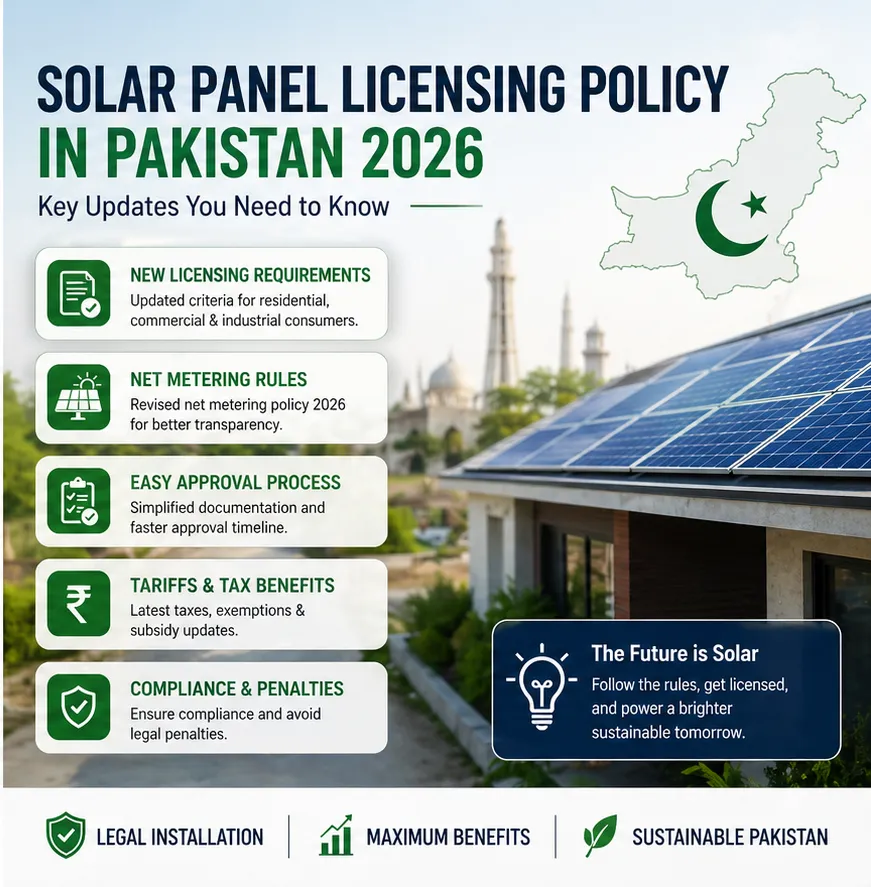
NEPRA’s Prosumer Regulations 2026 – a visual overview of the new licensing policy
Table of Contents
1. Introduction: The New Solar Panel Licensing Policy in Pakistan 2026
 On February 9, 2026, Pakistan’s power sector underwent a seismic shift. The National Electric Power Regulatory Authority (NEPRA) officially notified the Prosumer Regulations 2026, replacing the decade-old Net Metering Regulations 2015. This Solar Panel Licensing Policy in Pakistan 2026 affects over 466,000 existing solar users and millions of prospective ones.
If you’re a homeowner, business owner, or farmer who has invested—or plans to invest—in solar energy in Pakistan, this guide is for you. We’ll walk through everything: the shift from net metering to net billing, new licensing fees, buyback rates, and what the Solar Panel Licensing Policy in Pakistan 2026 means for your electricity bill.
At Gravity Engineering Solutions, we’ve helped hundreds of customers transition to solar. This guide aims to cut through the confusion and give you clear, actionable information about the Solar Panel Licensing Policy in Pakistan 2026.
External resource: Download the official NEPRA Prosumer Regulations 2026 (PDF)
On February 9, 2026, Pakistan’s power sector underwent a seismic shift. The National Electric Power Regulatory Authority (NEPRA) officially notified the Prosumer Regulations 2026, replacing the decade-old Net Metering Regulations 2015. This Solar Panel Licensing Policy in Pakistan 2026 affects over 466,000 existing solar users and millions of prospective ones.
If you’re a homeowner, business owner, or farmer who has invested—or plans to invest—in solar energy in Pakistan, this guide is for you. We’ll walk through everything: the shift from net metering to net billing, new licensing fees, buyback rates, and what the Solar Panel Licensing Policy in Pakistan 2026 means for your electricity bill.
At Gravity Engineering Solutions, we’ve helped hundreds of customers transition to solar. This guide aims to cut through the confusion and give you clear, actionable information about the Solar Panel Licensing Policy in Pakistan 2026.
External resource: Download the official NEPRA Prosumer Regulations 2026 (PDF)
2. How the Solar Panel Licensing Policy in Pakistan 2026 Changes Net Metering to Net Billing
To understand the new Solar Panel Licensing Policy in Pakistan 2026, we need to understand what changed.What Was Net Metering Under the Old Policy?
Under the old net metering system (2015-2026), solar consumers were “prosumers” – both producers and consumers. When you generated excess solar electricity, you exported it to the national grid. For every unit you exported, you received a credit of one unit that you could use later. This was a one-to-one unit exchange.What Is Net Billing Under the New Solar Panel Licensing Policy in Pakistan 2026?
Under the new net billing system introduced by the Solar Panel Licensing Policy in Pakistan 2026, the one-to-one unit exchange is gone. Now, imported and exported electricity are valued differently. When you export electricity to the grid, you get paid a lower “buyback rate” (around Rs8–11 per unit). But when you import electricity, you still pay the full retail tariff (between Rs37 and Rs55 per unit).
Key Takeaway: Under the old system, you could offset your entire electricity bill. Under the new Solar Panel Licensing Policy in Pakistan 2026, you will always pay a significant amount to the grid because import and export rates are unequal.
External resource: Visit NEPRA’s official website for complete policy documents
3. Licensing Fees Under the Solar Panel Licensing Policy in Pakistan 2026
Another major change in the Solar Panel Licensing Policy in Pakistan 2026 is the licensing and approval process for grid-connected solar systems.Old Process (Before February 8, 2026)
Under the 2015 regulations, systems of 25kW or less did not require a NEPRA license. Applications were processed directly by DISCOs with zero application fees.New Fees Under the Solar Panel Licensing Policy in Pakistan 2026
The 2026 regulations have centralized the approval process. All grid-connected solar users must obtain approval from NEPRA, regardless of system size. A one-time licensing fee of Rs1,000 per kilowatt (kW) applies. For a typical 5kW system, that’s Rs5,000. Off-grid systems are completely exempt. Important Note: NEPRA has emphasized that this fee is not a new tax. It is a one-time application processing fee for grid-connected users under the Solar Panel Licensing Policy in Pakistan 2026. Off-grid users are completely exempt.
4. Buyback Rates & Contract Changes in the Solar Panel Licensing Policy in Pakistan 2026
Perhaps the most impactful change in the Solar Panel Licensing Policy in Pakistan 2026 is the reduction in the buyback rate for exported solar electricity.Reduced Buyback Rate for New Consumers
For new solar consumers (applying after February 8, 2026), the buyback rate has been slashed to approximately Rs8.13 per unit – a massive reduction from Rs25.32 per unit. The Economic Coordination Committee (ECC) has approved a revised rate of Rs10 per unit, and NEPRA will finalize the exact figure soon.
See the difference for a typical 5kW system:
Under net metering (old): Export 500 units/month → Credit ~Rs12,650 against your bill.
Under net billing (new): Export 500 units/month → Credit ~Rs4,000–5,000 only.
Contract Duration Reduced to 5 Years
The license validity for new solar connections under the Solar Panel Licensing Policy in Pakistan 2026 has been reduced from seven years to five years (with an option for renewal).Protection for Existing Users
After widespread criticism, NEPRA issued a draft amendment to protect existing solar consumers. All existing net metering consumers will continue under their old billing arrangements until their contracts expire. If you submitted your application on or before February 8, 2026, you are protected under the old framework. External resource: Dawn News: Protection for existing net metering consumers5. Who Is Affected by the Solar Panel Licensing Policy in Pakistan 2026?
Let’s break this down by category to make it crystal clear. Existing Net Metering Consumers
You are protected. Your existing contract continues under the old net metering rules. The new Solar Panel Licensing Policy in Pakistan 2026 applies only when you renew.
Applications Submitted Before Feb 8, 2026
If your application was submitted on or before February 8, 2026, it will be processed under the old 2015 regulations.
 New Applicants (After Feb 8, 2026)
All new grid-connected solar applications fall under the new Solar Panel Licensing Policy in Pakistan 2026 with reduced buyback rates and 5-year contracts.
Off-Grid Solar Users
If you are not connected to the national grid, these regulations do not apply to you. No license or fee is required.
6. Step-by-Step Application Process Under the New Policy
- Apply to your DISCO: Submit your application to your local Distribution Company (IESCO, LESCO, K-Electric, etc.).
- Technical evaluation: The DISCO evaluates whether your proposed system can be safely interconnected with the grid.
- System approval: If feasible, the DISCO approves your application and both parties enter into a formal agreement.
- NEPRA concurrence: Before electricity can be exported, NEPRA must issue formal concurrence to confirm compliance with the Solar Panel Licensing Policy in Pakistan 2026.
- System activation: Once NEPRA concurrence is received, your system can be activated and connected to the grid.
7. How the Solar Panel Licensing Policy in Pakistan 2026 Affects Businesses
For businesses, the new Solar Panel Licensing Policy in Pakistan 2026 has profound financial implications.Extended Payback Periods
Under net metering, commercial solar systems often paid for themselves in 2-3 years. Under net billing, with the buyback rate slashed, the payback period could extend to 5-7 years or more.Shift in System Design Philosophy
Under the old system, businesses often sized systems to maximize export. Under the new Solar Panel Licensing Policy in Pakistan 2026, the optimal strategy is to size your system to match your daytime load as precisely as possible.
Pro Tip for Businesses: Evaluate your daytime load profile carefully. A system designed for “net zero” (generating exactly what you consume during daylight hours) will give you the best ROI under the Solar Panel Licensing Policy in Pakistan 2026.
8. Legal Challenges & Future Outlook
Constitutional Challenge Filed
RIAA Barker Gillette has filed a constitutional petition before the Islamabad High Court challenging the Solar Panel Licensing Policy in Pakistan 2026. The petition argues that the regulations fundamentally alter the compensation structure for solar consumers.What to Watch For
- Power Division’s Request: The government has formally asked NEPRA to scrap fees for systems under 25kW.
- Court Decision: The constitutional challenge could result in the regulations being modified or struck down.
- Buyback Rate Finalization: The exact buyback rate has not been formally notified.


 Gravity Engineering Solutions – Your Solar Partner in Pakistan
 Call/WhatsApp: +92-345-9088488 |